Wednesday, February 18, 2015

Teltowkanal 8

From Rip-Wolf to the Cement Works

This is the last of the winter. The February days dribble snow, and the basil on the kitchen windowsill huddles in its pot, looking depressed. Archangel, who checks the news and weather on his way out of bed in the morning, says unbelievingly: The weather forecast for today is "Dark."  Well, yes. 

This is also the last of the Teltowkanal--or strictly speaking, the first of it, since I've been walking upstream. Here the city dribbles out into chaotically half-built areas, reminiscent of those fringes of middling US cities where there are scattered little houses on outsize lots, lugubrious bars with no windows, and gun shops and places to get second-hand parts for your third-hand car.

My starting point today is not quite like that yet, however. The relevant U-Bahn station for this stretch is at the far corner of Gropiusstadt [see end of previous post]. The wall of highrises at my back here is a helpfully orienting object, like a small mountain range, when I come out of the unfamiliar station and can hardly tell one direction from another in the late-winter murk. 

Gropiusstadt isn't a slum, but it's a bit problematic. Somewhere I read a piece that used the following item as an indicator for Gropiusstadt's not being quite there yet, socioeconomically speaking. (Try using this question to test the okayness of your own neighborhood.) The question is: Does your neighborhood have rush hours on the public transit?  

The writer of the piece noted, with something between startlement and horror, that the U-Bahn stations in Gropiusstadt were quite busy for a couple of hours in the morning and a couple of hours in the evening, and then the rest of the time they weren't busy. What an uncomfortable and undesirable thing, thought the writer of the piece. What an un-Berlin kind of thing. (When have I seen the trains busiest on the Stadtbahn, the backbone of the Berlin transit system? The rush hour is not obvious. Summer Sunday evenings when people are coming home from the woods? Saturday nights when the young are headed for the clubs? Weekday midafternoons when the kids get out of school?) 

The idea of this criterion is that a real neighborhood is multi-purpose (and life is multi-purpose), and therefore people are coming from the neighborhood and going to it in all directions at all hours of the waking day and night. The  neighborhood is not just a place where people are warehoused in their (rigidly designated) off-work hours. (Ah, this was the great mistake of the modernist city-planners in the twentieth century. They were right about Light! Air! Sunshine! [see previous post] But they were wrong about functional separation: the idea that residential and commercial and industrial areas should be quite separate, all sealed off from each other. Terrible idea.) 

So Gropiusstadt is a bit too residential-warehouse-like, and some of the industry down here has an un-integrated look as well. History has been rather hard on the area. Having left Gropiusstadt half a mile or so behind, I am in Rudow, which in Cold War days was the last little dangling southeastern bit of West Berlin, surrounded on three sides by the East. The roads stopped here, the rails stopped here, people didn't come here much. Now people pass through, without stopping, along the new freeway that goes down to the nonusable new airport (and on south to Saxony). The place has a semi-coherent, semi-existent sort of feel.

Beyond the bridge where I quit last time, I have a choice of routes. I could cross to the other side of the canal, to a bicycle path that runs narrowly between the water and the freeway fence (and cyclists complain on the web about doddering old pedestrians getting in their way when they're zinging along in eighteenth gear). Or I could stay on this side, on Canalstrasse, where I will see the front of the industry that backs on the canal. Or maybe the back of the industry that fronts on the canal. 

Well, Canalstrasse for me: I don't want to breathe auto exhaust for the next hour, and industry is fun, at least sometimes. The industrial strip along the canal, close to the new freeway, looks fairly flourishing. This is good.

The older buildings--refitted and in use--are dignified with red brick and formal design features: the medallion in the gable, the symmetrical window placement, the brick relief panels between the windows. Newer buildings on the street have a form-follows-function character; here, in an expiring breath of classicism, form still follows rules.

On Canalstrasse, Rudow. February 2015. My photo.

Much of the street is occupied with little recent-ish business parks with room for six or eight firms, mostly of a metal-bashing or building-related nature. There are also bigger outfits that have whole building complexes to themselves: roofers, tile-layers, firms that do environmental cleanup, a firm that puts coatings on things. 

There is a sizable-looking firm called Rip-Wolf that will destroy data for you, in either paper or electronic form. (Okay, I know that Rip-Wolf (Reisswolf) is just the German word for shredder, but the English cognate makes an excellent word, and the firm logo does have a wolf-head on it.)   

I am not sure what the people with the bright yellow shed do, other than provide interesting streetscape. (How I love the (unclassical) form of this, the tower with the loader that goes back to the canal, and then the deep-lemon shed that livens up the monochrome of the winter street.)


On Canalstrasse, February 2015. My photo.
**

Canalstrasse is not long, and the trick will be finding a place to get under the highway and back to the water when the street comes to an end. This is straightforward enough if you go down to the next substantial street, but that's somewhat out of the way, and according to one map there is a footpath shortcut that stays closer to the water. According to other maps there is no such thing, but let us travel hopefully.

The shortcut appears to go through a large Mercedes truck dealership. I feel awkward--do I look like a customer for large Mercedes trucks? But I can see the highway up there, and it looks as though there is really an underpass. 

Yes.  I have made it through the endless lines of vehicles for sale without being challenged by salesmen or run down by customers, and here we go under the highway. We are crossing from the last of the old West to the old East, from Rudow to Altglienicke. 

Some of the territory on this side is still a bit unreconstructed-East, broken-windowed in the winter cold.

On Rudowerstrasse, east of highway, February 2015. My photo.

Once under the highway, I turn north, back toward the water. And here is the reconstructed East, with awkwardly scattered new housing and a very large plastic palm tree in someone's yard.


Am Bruchland, February 2015. My photo.

Well, well.  Here, just by the plastic palm, we are at the water at last. Not beautiful, but I do want to record the achievement of getting to the waterside again:


Teltowkanal, Altglienicke, February 2015. My photo.

I disturb a heron fishing in the canal, who flies off with angry cries. The herons in center city are not so shy, but there's no one out on foot in these parts, and the herons are unused to company. 

You couldn't tell from this stretch, but there is actually a long history of settlement in this part of Berlin. There are remnants of Bronze Age hearths. There was a Germanic tribe here in Roman times, and Slavic settlers later, and then Germans again. The name of the village in the Middle Ages was Glinik, from the Slavic word glina.

Glina means mud. Yes. The street looks relatively respectable in the picture below, but in some places there are iced-over potholes in which you could lose a small motorcycle. 


Am Bruchland, Altglienicke, February 2015. My photo.

How desolate these little streets with their separate houses are ...  And presently we plunge into a stretch of Kleingärten. But these are a bit different from their counterparts on the west side of the highway, where the garden-associations have names like Harmony and Edelweiss. Here they have names like Luna Park and Land Reform, and the garden-houses are sometimes more makeshift:


Kleingarten along Teltowkanal, February 2015. My photo.

Or kitsch run wild:


Kleingarten along Teltowkanal, February 2015. My photo.

**

We come to the Altglienicke Bridge over the canal, which is a sad mess. It was blown up in April of 1945; a few years later, the pieces of the bridge were lifted out and put together again in a makeshift sort of way that kept having to be patched up in the subsequent decades. In 1995 a temporary bridge was put in nearby, to carry the traffic while the old bridge was either replaced or rebuilt properly. 

"But then," says an Altglienicke website, in an absolutely classic Berlin-building-project sentence, "suddenly there was no more money." Doch dann war plötzlich kein Geld mehr da. (Oooh, that's the end of so many stories here--or at least it's a long pause in the story.) The temporary bridge turned out to have been placed too low to let the biggest canal-freighters through, so money was scrabbled together to raise it a couple of feet. By now the temporary bridge has started to go through a close-patch-reopen cycle like the old bridge--since, in twenty years, the project to put in a solid permanent structure has never moved forward. 

Construction debris lies here and there along the water. (Agh, why are some construction projects such long-running farces here? Others go well enough.)


Near Altglienicker Brücke, February 2015. My photo.

The next bridge pair carries the Adlergestell, the "eagles' path through the woods"--the longest street in Berlin--and the railroad that runs beside it. Under the bridges the good Brandenburg sand of the path is ankle-deep. What is to be done for bicyclists, who would sink to a dead stop into this? Pave the path? Naah. Lay matting across the sand--and this sort of works, as I see from the progress of the bicyclist up ahead of me. (I squelch happily through the deep sand; I like sand-walking.)

**
On the other side of the Adlergestell we are suddenly in a different world--and a different sub-district too, having left Altglienicke behind and entered Grünau. Instead of "old mud" we have "green meadow"--a place-name given hopefully by the Rhinelanders who were settled here as immigrants in the eighteenth century and thought they could turn the banks of the Dahme into a wine-growing region. (Not a chance, folks.)

Although the Dahme does not warm its banks enough to support wine-growing, it has other uses. We are not far from the so-called regatta stretch of the river, which was the site for the canoeing and rowing events in the 1936 Olympics and is still a moderately busy boat-race site in the summer. The opposite bank of the canal for the next kilometer or so is nothing but boat storage.


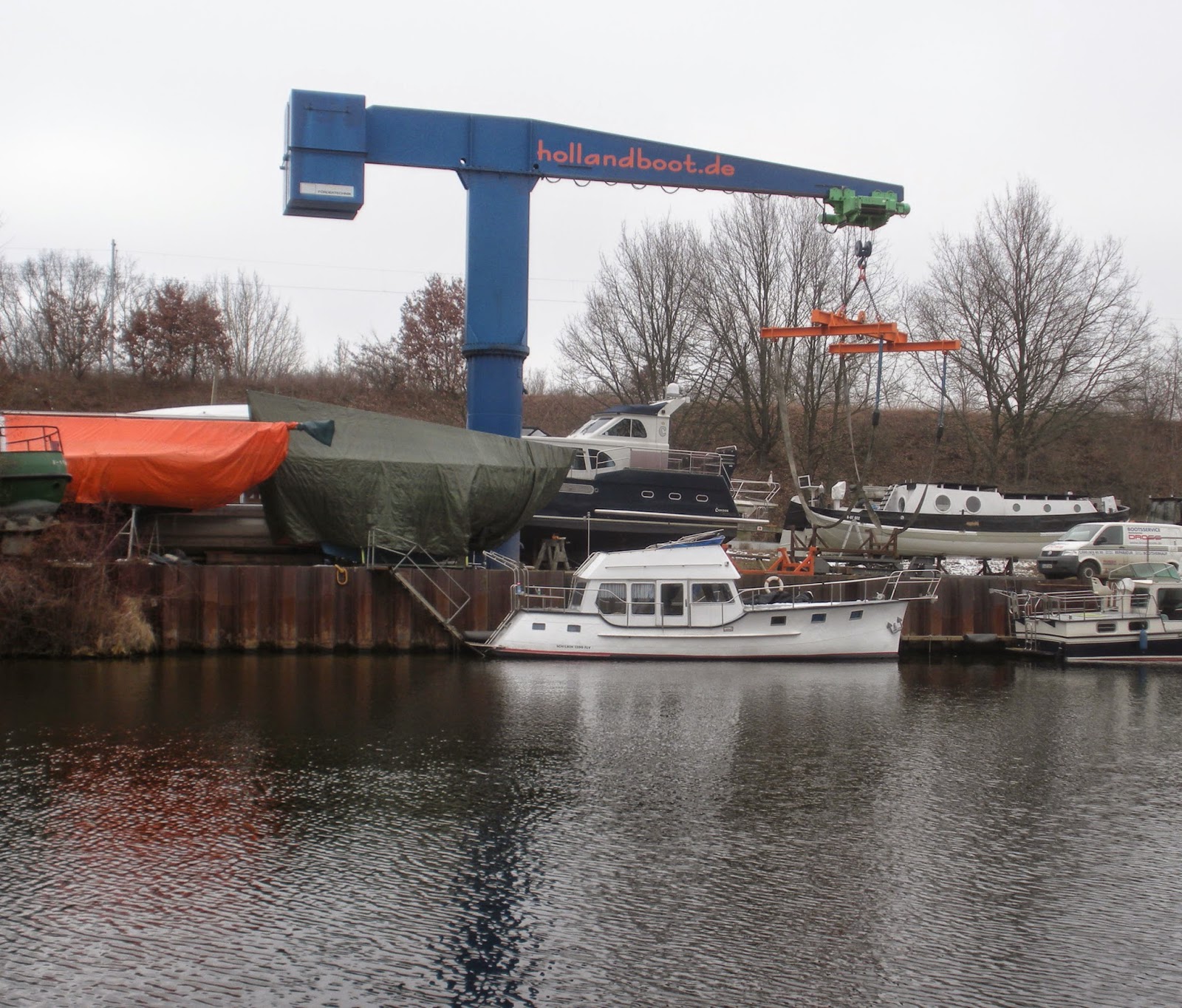
Boat storage along Teltowkanal, February 2015. My photo.

How winter-dreamy this all is. Everything here is stopped, wrapped up, asleep, waiting for summer. Boats are parked in the water, on the shore, back among the trees--looking, at times, as if they had floated up in high water and stranded among the branches.


Boat storage along Teltowkanal, February 2015. My photo.

I'm counting bridges. This is the Outer Ring railway bridge, the fifty-fifth of the fifty-six bridges over the Teltowkanal. 

Railway bridge, east end of Teltowkanal, February 2015. My photo.

Now that we are out of the fragmented provisorium of Altglienicke, there is actually a bench by the water. Not something I have seen for miles of messy, confusedly privatized waterside:


Near end of Teltowkanal, February 2015. My photo.

If it was not absolutely freezing outdoors, I could sit here and have some lunch and read Kierkegaard and admire the cement plant across the water. I like cement plants, though this one is terribly melancholy-looking compared to the one up on the Spree, not so far away [see Spree 6 post, June 2014]. 


Cement plant, Teltowkanal, February 2015. My photo.

This one looks rather like a prison, in fact.


But here we are at the last bridge. Here is the water-junction, where the canal meets the Dahme, that fat water-street that laps against the boat-builders' sheds on Regattastrasse and carries traffic from Berlin to Poland and the Baltic. 


Teltowkanal - Dahme junction, from Grünauer Brücke, February 2015. My photo.

Bleak and Februarized as it can be. But there is a gently clattering streetcar crossing the bridge, pausing at the nearest halt (named, reasonably, Cement Works)--and I see that this line is the wonderful number 68, that runs down to Alt-Schmöckwitz, a remote corner of Berlin on a sort of peninsula where the Dahme sprawls out into lakes. 

I adore the 68. It runs more or less parallel to the Dahme, and for some way it runs through the forest--no street, just the poky little tram humming through the trees, with properly signed and scheduled stops in places where you would hardly expect anyone but a wild boar to be waiting.

Well, when the leaves start coming out, we will walk down through the woods along the river to Alt-Schmöckwitz, and then we will take the 68 back again.

Now it's time to get to the S-Bahn and go home to where the city is more solid. Time to wake up the cat, toast myself against the living-room radiator, and enjoy the last outburst of bloom from my Christmas amaryllis, before the spring gets under way.


Amaryllis and cat, February 2015. Photo, M. Seadle.

Tuesday, February 10, 2015

Teltowkanal 7

The Beautiful Junkyard Across From the Marzipan Factory

Late January morning. Back to the Blaschkoallee U-Bahn stop with the midsummer-daydream pictures on the station walls:


U-Bahn station wall, Blaschkoallee, January 2015. My photo.

This looks like a picture of Schloss Britz, which is not far from the station. When the winter is over I must get Archangel to come down here and explore. 

And perhaps we would walk to the south side of the neighborhood too, to the Britzer Garten. Perhaps in tulip time. 


Britzer Garten, tulips. Photo, Wiki Commons.

In the Britzer Garten there is a cafe with a sort of micro-library in it and an outdoor terrace on the edge of a lake, where I once spent a summer afternoon working out a theoretical problem in statistics. (Nothing very complicated: Archangel can do proofs of this sort in his head, but I can't get through them without making little numerical examples and waving my fingers.) 

This is still my picture of a kind of paradise of leisure and freedom: to sit outdoors on a perfect summer day, by the water, under the trees, in a garden, learning math that it not terribly urgent for me to know. (Math is not something I am very good at, any more than I am good at gardening: but how beautiful they are, the theorems and the tulip-beds.) And how is it that we do not get to our paradises of leisure and freedom? The last time I was at the Britzer Garten was seven years ago. But this summer, perhaps.

**

Last time I was down here for a canal walk I was in the end stages of a bad cold and I wasn't paying attention any more by the time I got to the U-Bahn station. But this time, being more alert, I saw that there was something excessively pink looming up just behind the station entrance:


At Blaschkoallee U-Bahn Station, January 2015. My photo.

So I got sidetracked. I should have gone east to the canal, but I wandered off to the west to see what was on the other side of the station. It was a handsome line of apartments, but I couldn't seem to get the right angle for a photo without falling into the garbage dumpsters or otherwise embarrassing myself; so I am borrowing someone else's photo from a mellower time of year.


On Fritz-Reuter-Allee. Photo by Mangan2002, Wiki Commons.

Well, this is rather nice, I thought. So then what happens if we go to the next street? 

More wonderful color.


On Liningstraße, January 2015. My photo.

This has to be Bruno Taut, I say to myself--the advocate of strong color in architecture. How good these places make me feel. (Sing and shout, it's Bruno Taut!) 

If I had had a better grip on where I was, I would have realized that I was up on the north edge of the Hufeisensiedlung, Taut's greatest Berlin project. I hadn't realized the Siedlung stretched up this far. This is just the trailing edge, not the main part.

How would we translate Siedlung into American English? "Housing project" isn't right because it sounds like a dump, and Siedlungen aren't dumps. "Housing development" isn't quite right, because that sounds commercial and the great Berlin (and Vienna) Siedlungen like this one were not commercial ventures. 

The translation problem works the other way too. I have been reading a German dissertation about post-World-War-II city planning, which uses the term Siedlung indifferently for the worst housing projects in the US--places that have been dynamited out of existence like Pruitt-Igoe in St. Louis and Mill Creek in Philadelphia--and for places like Reston, Virginia, that land up on "Ten Best Places to Live" lists. In English there are separate words for these separate types of places, but not in German. (No term has been created here for "planned, state-subsidized slum." Guess why.) [Regina Fiorito, Wohnsiedlungsarchitektur der 60er Jahre in den Vereinigten Staaten von Amerika und Deutschland - Eine vergleichende Untersuchung. Universität Köln, 1999]

Not that Berlin did not have slums. The population of Berlin quadrupled in the last half of the nineteenth century--it was the most populous city in the world after London and New York then--and housing construction did not keep pace. It was, in part, a capital-allocation problem: when new industries were booming, and new workers coming in by the tens of thousands, capital flowed to the lucrative new industries and not so much to construction, which offered lower returns. It was only in slack times for other industries that it was attractive to put your money into construction. So when the need for housing was greatest, the supply was slow to respond. [Renate Banik-Schweitzer Wohnverhältnisse in Berlin, Wien und Budapest um die Wende zum 20. Jahrhundert, Siedlungsforschung. Archäologie-Geschichte-Geographie 5, 1987, S. 177-204.]

Here our introductory economics text will say: Ah, but then because housing is in such high demand and short supply, rents will rise (Berlin has always been a renters' city). Returns on construction will therefore rise and soon there will be enough housing. This works well enough for the people who have the money to pay higher rents, and indeed, substantial portions of Berlin were built on these terms. But then, there were also many people who did not have the money to pay higher rents. For them there were other solutions that I do not recall appearing often in introductory economics texts. One was to crowd more people into the same space--and although the resulting conditions would kill some of them, it would not kill enough of them, fast enough, to endanger the labor supply seriously. As this solution did not commend itself to everyone, there was also some growth in not-for-profit housing of various kinds.

Cooperative housing expanded in Berlin toward the end of the nineteenth century. Big firms kicked in capital for co-ops for their workers, unions assembled funds for their own co-ops, and the state helped out: the German national pension and disability-insurance system, founded in the later nineteenth century, invested some of its funds in providing long-term low-interest loans to the co-ops. The co-ops still make up about 10% of the Berlin housing supply--not a lot, and they aren't grand places, but they do help. 

(They don't work like US co-ops: you don't buy your apartment at the market rate--since, after all, part of the purpose of these organizations was to take housing out of the speculative asset markets. Instead you pay a small one-time entry fee and then a modest amount for the shares that that entitle you to a specific apartment. In what I believe is the biggest co-op in Berlin, the current entry fee is 110 euros, and the shares cost 160 euros per 5 square meters. So a place the size of our apartment would cost about 2400 euros to buy into. Then you pay a monthly fee that covers your share of the costs of running the place--substantially less than commercial rents.)

Of course there weren't anything like enough co-ops for everyone who couldn't afford a for-profit apartment, and not everyone could scare up the historical equivalent of even a couple of thousand euros to get in. At the end of the First World War almost another quarter-million people crowded into the city, displaced by post-war boundary shifts. A one-room apartment with a kitchen counted as overcrowded in Berlin only if more than four people lived in it. [Hufeisensiedlung, German Wikipedia] 

The poorest neighborhoods were packed deathtraps, breeding-grounds for tuberculosis, typhoid, and the like. When Käthe Kollwitz came to Berlin from Königsberg with her husband in the 1890s, he set up a medical practice in such a neighborhood, and you can see from the prints and drawings in the Kollwitz-Museum in Berlin what it looked like: the parents with dead children, the children with dead parents. Not really better in 1920 than in, say, 1895, when the Kollwitzes were young.

Käthe Kollwitz, Mother with dead child.

But by 1920 other young professional people had also come from Königsberg to Berlin. (Ah, Königsberg, the capital of Prussia, where Immanuel Kant lived nearly all his life, revolutionizing European philosophy, having guests at his dinner table every day and telling them jokes because laughter is good for the digestion and you aren't going to get through the work that it is your duty to do in the world without a good digestion. Königsberg, where the Electors of Brandenburg declared themselves kings of Prussia (safely outside the bounds of the Empire, within which they could not have declared themselves kings without the Emperor's permission). Do people come to Berlin from there now? Perhaps. Now it's called Kaliningrad: a Russian exclave in Poland, living--not so well--by smuggling and black-marketeering and prostitution and a bit of Kant-tourism. "The Calcutta of the North," a German newspaper calls it. ["Der gute Deutsche von Kaliningrad," Süddeutsche Zeitung 17 May 2010])

Here is young Bruno Taut, lately come from Königsberg and about to set up his own architectural office in Berlin with his new friend Franz Hoffmann. Bruno's younger brother Max would join them a few years later.


Bruno Taut, 1910. Photo, Wiki Commons.

The new architecture firm has its ups and downs. In the war, Hoffmann lands in the army, but manages to survive. Bruno Taut (does this asthmatic little man look like soldier material?) supervises the construction of a powder factory and writes an anti-war manifesto. (Käthe Kollwitz creates devastating anti-war prints.)  

Architecture jobs are not so easy to come by in the economically shaky years after the war. To keep afloat, Taut does theater designs; he takes time to theorize about building and city-planning. He designs an attendant's hut for an exposition in Magdeburg; it isn't built, but the plans are published and a version is built, years later, as a house for a writer in the artist's colony at Worpswede, outside Bremen. People like it; they call it the "Worpswede cheese cover."


The "Worpswede cheese cover." House by B. Taut.

Well, I dearly love Bruno Taut, who arguably was the great artist in building the Berlin Siedlungen, but equal honors should probably go to Martin Wagner, the organizer. Who lights candles for great bureaucrats, who leaves roses on their graves? People should. Wagner, who came from Königsberg to Berlin at about the same time as the Tauts, half a generation or so after the Kollwitzes, was one of those people who has "committee chair" stamped on his forehead in letters that other organizationally competent people can read. (He was also an architect, but it was probably more important that he was someone who made things happen--a Gestalter, the Germans say.)

Wagner founded and led an organization of union-related housing cooperatives, the Association of Social Construction Firms. He was the head of a housing-related offshoot of the socialist German unions, the Imperial (later German) Housing Aid Society for Civil Servant, Employee and Worker Homes. (One doesn't say long thumping names like this in German. All the long names have their pronounceable acronyms: the housing aid society was first REWOG, later DEWOG.) It was made up of local branch organizations: the Berlin branch was GEHAG, the Nonprofit Home, Savings, and Construction Corporation. Which still exists, after a fashion.

The Hufeisensiedlung here in Britz was a joint project of Taut and Wagner, of GEHAG and the city of Berlin--of which, by 1926, Wagner was the city building officer. Like most people with "committee chair" stamped on their foreheads, he knew that you have to be able to finance your ideas, and that you have to be persistent. In 1916 he had started to call for a tax on real estate to fund more low-income building; after eight years of persistence he finally got it. (The hyperinflation of the early 1920s had wiped out the debt of people who had borrowed money earlier to acquire income-producing property; by 1924 there was some public feeling that these folks should share their windfall.) For the next eight years there was a tremendous wave of nonprofit, state-subsidized building, paid for by the new tax and designed by great architects like Taut and Walter Gropius and Mies van der Rohe and Hans Scharoun. (Scharoun is not so much of a name in the US, but you can't miss him in Berlin.)


Berliner Philharmonie, by Hans Scharoun. Photo, Manfred Brückels, Wiki Commons.

So a lot was built, in Berlin and elsewhere, during the "house tax era," as it is sometimes called. Decent housing, mostly apartments, some row houses. Plain, handsome, well-built, safe, full of "Light! Air! Sunshine!" as the architects' battle-cry went.

All this ended badly. When the Nazis came to power, they started taking the house tax revenues for other purposes. In 1943 they demanded that owners buy themselves out of the tax by paying ten years' worth of the tax at once; it was an important contribution to the financing of the war. 

Long before this, Wagner and the Tauts and their friends were in trouble. Hitler's first priority was not the economy or the military, it was the arts. He became chancellor at the end of January, 1933, and cleared his artistic enemies out of the academies and universities before doing almost anything else. In February, Käthe Kollwitz and Bruno Taut were booted out of the Academy of the Arts in Berlin, and Wagner quit the Academy in protest. In March he lost his job with the city; Taut was removed from his technical-university professorship; they were essentially unemployable in Germany.

Like many intellectual and political figures in trouble with the Nazis, Wagner and Taut ended up in Turkey. (Turkey was full of Germans before Germany was full of Turks--it's a long-standing connection. Paul Hindemith founded the music conservatory in Ankara; Ernst Reuter--later the mayor of Berlin, the man who pulled it through the angst-producing days of the early Cold War--worked for the Turkish government in the 1930s, re-organizing the railroad price system, and teaching city planning to aspiring Turkish bureaucrats.) 

Martin Wagner worked for a few years in city planning in Istanbul; Bruno Taut was a professor of architecture there and designed university and school buildings. (Brother Max lay low in a small Brandenburg town with his in-laws; he had married the daughter of the local innkeeper and blacksmith. Bruno had married the other daughter, but it hadn't lasted so well.)

In 1938, the last year before the war, Wagner got out to the US, to a professorship at Harvard. One of nature's committee chairs, one of nature's Harvard professors: it's that writing on the forehead. Perhaps something might have been arranged in the US for Bruno Taut as well, but before year-end he was dead, killed by an asthma attack on Christmas Eve. (The great advocate of Light! Air! Sunshine! suffocating in the winter dark of a strange city.) 

They seem to have liked Taut in Istanbul. He was the first (and perhaps still the only?) foreigner and non-Muslim to receive the honor of burial in the Edirnekapi Martyrs' Cemetery in Istanbul. (Where tradition says the fallen soldiers of 1453 were buried--the ones who captured Constantinople for the Turks and put an end to the Byzantine Empire. But the tradition may not be true.) 

In Britz, the stretches of intensely blue houses alternate with stretches of red and yellow houses, picking up their bit of Light! Air! Sunshine! in the gray January morning.


On Liningstraße, January 2015. My photo.

I must come back, in the spring, and explore properly. But this is not spring, and this is not the direction in which the Teltowkanal lies, so let's backtrack a bit, back to the U-Bahn station and back along ugly Späthstrasse ...

Here we have a five-foot high hot dog pouring ketchup on itself, wrapped in the American flag, advertising a snack joint down the street.


Hot dog ad on Späthstraße, January 2015. My photo.

But we mustn't give up on streets--this one gets more interesting further on.

Here is a fine sort of neo-Romanesque auto repair place. (These folks had a post on Facebook last year: "Today is Valentine's Day, give your sweetheart something really different, like an auto inspection.")


Auto repair shop. Späthstraße, January 2015. My photo.

And then comes a marzipan factory, floating a pleasant faint almond-paste fragrance into the winter morning.  Across from it is a junkyard with the most wonderful fence, perhaps inspired by the neighborhood colors. (The firm will dismantle your old assembly lines or elevators or heating systems: "clean, punctual, and conscientious," says the advertisement. Dear junkyard, thank you for the beautiful fence, say I.)


Beller Dismantling, Old Metal, and Scrap, Späthstraße, January 2015. My photo.

And here we are at the water, at last, in its winter dimness.


Teltowkanal, Britz, January 2015. My photo.

The fence on the other side of the water (which you can barely see) in the background is screening a freeway; on this side of the water is a long stretch of Kleingärten, very dead in the winter. Though you can smell smoke--people with woodstoves burning in their little garden-houses, or possibly a bit of illegal bonfire somewhere--and there are a few people out, already doing end-of-winter cleanup. (It will snow again, of course, but you might as well get a start on the spring work.)

The garden associations have names like Harmony and Peace Garden and Edelweiss. There are posters on the fences and the canal-side trees announcing that the Edelweiss canteen is having an Eisbeinessen, a ham-hock feed, on the weekend. You really have to be German to go for Eisbein, I think (also called Schweinshaxe): we won a canned version in a Christmas charity raffle this year, and we haven't brought ourselves to open the can yet.


Eisbein/ Schweinshaxe at Schweizerhaus, Vienna. Photo, Clemens Pfeiffer, Wiki Commons.

**

Walking along the back of the Kleingärten isn't as boring as I was afraid it would be. The bones of the trees stand out at this season: it's a fine day for tree-structure. There are willows:


Along Teltowkanal, January 2015. My photo.

Oaks, I think--young ones, without the massive horizontality they will have later:


Along Teltowkanal, January 2015. My photo.

A birch tree, filigree-fine against the winter cloud.


Along Teltowkanal, January 2015. My photo.

I stop at the Massantebrücke (number 47 on the list of bridges over the Teltowkanal--and there are only 52 altogether, so we're getting close to the end). No more path on this side of the canal, according to the map. It's time to head home again: I'm doing short stretches on these chilly January days. 

I pick up a bus which will go to an U-Bahn station, and which also turns out to provide a tour of the east side of Gropiusstadt, the huge 1960s-70s development on the southern edge of Berlin. 

This was intended, at least in some views, as an extension, a bigger version, of Bruno Taut's and Martin Wagner's project in Britz. But Gropiusstadt got sort of out of hand. 


Gropiusstadt. Photo by Photocapy, Wiki Commons.

It's a vast place, almost nineteen thousand apartments. Walter Gropius himself drew up the initial plans but died before it was finished, and the realized version does not bear so much resemblance to the plans. The city, anxious about its lack of expansion room after the Wall went up, added buildings and subtracted green space. GEHAG, which had built Taut and Wagner's Hufeisensiedlung and was now a city-owned corporation, had responsibility for a big chunk of the building. 

GEHAG still owns and operates portions of the Hufeisensiedlung and Gropiusstadt. But it's not a nonprofit any more. It was privatized in 1998, bought by an American mutual fund and a German bank in 2005, and flipped to a publicly traded German company in 2007. Not a great moment to acquire real estate. We will hope this all works out. (Rest in peace, Bruno Taut.)

**

Martin Wagner came back to Germany once for a postwar visit and hated it. He wasn't just being a cranky old man. He and the Tauts had imagined beautiful, humane, well-built cities; and in the (necessary) rush to rebuild after the war, much that went up was ugly and brutal and poorly made. And it would block the streets for generations; the lost opportunity was a bitter thing for him.

Wagner's last piece of writing, finished just before he died in 1957, was a polemic against the neighborhood where we live, which was then on the drawing board. The planning was too expensive, it didn't really correspond to current social needs, Wagner said. Possibly true. But, well, it was an available opportunity, it was better than leaving the neighborhood lying in ashes, as it still was, fourteen years after it had been bombed flat. Others of the old Siedlung-planning crowd--Walter Gropius, Max Taut--were contributing buildings to the neighborhood.

And it's not so bad, Herr Wagner. It doesn't catch at the heart like the best of Bruno Taut's work. But we do have Light! Air! Sunshine!--no north-facing apartments here, the architects were very careful about this--and a bit of color here and there in the buildings, and room for the linden trees that will knock your head back with fragrance in the early summer. The neighborhood holds as many people as it did in its pre-war version and has three times the green space that it did before. (Neatly done, planners!)

The neighborhood sort of melts into the northern edge of Tiergarten: our street runs like a river of trees into the sea of trees to the south. If I go out of our front door, past the not very attractive Max Taut house across the street and then past the Academy of the Arts, I come to a sheltered spot in the park where the snowdrops are almost ready to open, and the winter aconite buds are fat and yellow and would be ready to burst if the sun were ever to come out again--which looks like a long shot at the moment. (Fog, says the forecast for today. Fog, says the forecast for tomorrow. Cloud, says the forecast for the day after that.)


Saturday, January 31, 2015

Teltowkanal 6

Crow-weather in the neighborhoods

Orange was a popular color here in cold-war days, especially in the old east. The Palace of the Republic, the East German seat of government, was orange. (And these days you can buy East German souvenirs in a Berlin shop called VEB Orange. VEB was the label for state-owned companies in East Germany: "the people's own firm," Volkseigener Betrieb. In the shop it is supposed to stand for "many memories remain," viele Erinnerungen bleiben.) The Palace of the Republic is gone, knocked down and loaded into barges and floated away on the Spree to some building-materials graveyard. People don't build orange buildings any more.

But in the colorless winter, the 1950s orange buildings in our neighborhood warm the cityscape. Most of the city is white or gray or manila-folder colored, ranks of concrete-slab buildings like racks full of manila folders half lost in the fog. We appreciate moments like the one below, when the sky lifts a bit and you can see beyond your own block. In the winter the city is so muffled in the mist of its own breath, sometimes you can’t see past the next cross street for days on end. 

View from living room, December 2014. My photo.
**
Things seem muddy and shabby and broken-down in the late winter. When I am out on errands in one of the scuzzier parts of the neighborhood I see that a dead mattress has been dumped in front of the Embassy of Tadjikistan, blocking the bicycle path in a somewhat hazardous way. (Richer countries nabbed the more elegant embassy sites when the capital moved back to Berlin in the 90s, and people like the Tadjiks and the Hondurans ended up in potluck neighborhoods like ours.)

Ah, but it's not so bad as thaw time in the Midwest, when a long season's worth of snow starts to retreat like a receding glacier, leaving behind moraines of french-fry wrappers and lost mittens and dog turds along the sidewalks.

**

Now I am on my way out for a morning of exploration along the canal, and find that things are a bit out of order: the escalator is broken at the Bundesplatz U-Bahn, the escalator is broken at the Herrmannplatz U-Bahn. (The sand and slush that people track in from the street get into the escalator mechanisms in the winter; the repair workers bang wearily on the metal.) Young women struggle on the stairs with baby strollers. 

The U-Bahn takes off with a sudden jerk just as I am swinging my backpack off and am a little off balance. I land on the feet of the woman across from me, a sturdy fifty-ish Berlin type with electro-orange hair. I apologize, she laughs and says, My feet are a soft landing place. And so they are: big padded boots.

The Herrmannplatz stop, where I get out, is on the south (less gentrifying) side of Neukölln, which is, along with Wedding, regarded as the worst neighborhood in Berlin. 


Hermannplatz. Photo by Alex1011, Wiki Commons.

The street is lively. Here are cheap cell-phone places, money-transfer places, bakeries; here is a storefront that is vacant except for a mannequin in an elaborate wedding dress and a gas mask. Here are apartment houses dotted with satellite dishes; here is a dress shop with beautiful Muslim fashions, slinky long dresses with coordinated headscarves. (The young women bicycling past in the slush are doubly wrapped up, with woolly hats and heavy mufflers over their scarves.) 

The dress shop reminds me of a list I keep in my mind of the odd lots of things that people buy in our (excellent, Turkish-run) neighborhood supermarket. Maybe this is amusing only if you're used to US-style grocery shopping, in which people go once a week or so and the purchases are therefore extensive and diverse. They don't really tell you much about your neighbors except whether they live on frozen dinners or do their own cooking. Here, where you shop every day or every other day (and can be in and out of the store in about ten minutes if you're efficient), people do buy curious little assortments:

    - Middle-aged professional-looking man: three bottles of whiskey and a large
      bag of kiwi fruit. (What kind of party is this going to be?)

    - Very young man: two extra-large pizzas and six beers. (You know what
       kind of party this is going to be.)

    - Elegant young Muslim woman in silk headscarf: latest issue of Vogue and a
      bag of gummi bears. (Looks like a quiet evening at home.)

... And then there was the old woman who wanted some fresh radishes but not the whole bunch, the way the store was selling them. 

Pick out as many as you want, said Ali the cashier, and we'll charge by weight. (You can buy as little of anything as you want here; you can buy a single egg, if you like.) She picked her four or five radishes and gave them to Ali with a suspicious look. Don't weigh the tops, I don't want you to charge me for the tops! So Ali, who is a dear patient man, took the tops off for her and weighed the radishes. 

You can have the tops if you want them, he said. She glared at him. I don't want the tops! 

The neighborhood postman was standing at the end of the counter grinning, waiting to hand Ali a stack of letters. Does anyone have a rabbit at home? he called out to the store at large. Free greens! 

And I think of the supermarkets elsewhere, where the cashiers are timed to make sure they're maximizing throughput; and if you're at the wrong end of the timing distribution you get fired or re-educated. Sad hearts at the supermarket ....  I like our neighborhood. 

**
In a half mile or so I'm back to the canal and in the sub-district of Britz, which is quieter and less used-looking than Neukölln:


Along Teltowkanal near Britzer bridge, January 2015. My photo.

The Smell still drifts across the path from time to time. Same as in the last stretch of the canal, a sort of rotting-coffee-grounds smell--but where can it be coming from? It's intermittent. Maybe it's coming up with the steam from the manholes? I can't tell. 

There are surely additional rotting things in the abundant trash along the park strip by the canal. A lot of public space in Berlin could use more frequent trash pickup. (I used to get annoyed because there was trash scattered on the ground around half-empty trash bins in our part of town. Can't people get their trash in the bins? I thought, or can't the city crews take the time to pick up the mess? This was unfair, however, as I discovered when I saw the neighborhood crows--the big gray-backed crows that dominate the Berlin sky in winter--at work on hitherto orderly bins. They would dig down and fling out one thing after another, scattering the bin contents all over the ground, aiming for some crow-preferred tidbit further down in the bin. They seem to have a taste for cheap pizza.)

Ist ein Krähenwetter, you can say in German, of the drearier stretches of winter. It's a crow-weather.

**

The path is well-marked here, where you couldn't possibly lose it anyway; the blue-and-white blazes on the trees remind us that the Teltowkanal path is number 17 of the twenty main greenways through the city. 


Along Teltowkanal, east of Hermannstraße, January 2015. My photo.

The path along the Spree, which we followed last summer, is number 1.  The path along the Havel, which we will try when spring comes (that hardly imaginable event) is number 12. (But how long will it be, really, until the first crocus are out along the water and the sun comes back? Maybe not so long.)

**

The next bridge, with its pleasant bunches of chestnut leaves wrought in the railing, is the Rungius bridge. Named, I discover, for one Heinrich Rungius, a minor Protestant theologian and pastor in Neukölln in the nineteenth century.


Rungiusbrücke, Teltowkanal, January 2015. My photo.

Rungius, Rungius--  Why does this name sound familiar? I don't know anything about minor Protestant theologians of the nineteenth century.

Ah, but I was once in Cody, Wyoming, making a run out of Yellowstone, with an early snowstorm riding the bumper, years ago. We stopped at the Buffalo Bill Center, where the museum of western art has some works by Carl Rungius, the first really successful wildlife painter in the US, the picture-maker for the world that Theodore Roosevelt and his friends inhabited, or liked to imagine themselves inhabiting. (It's magazine-illustration stuff; there's much more of this sort of thing elsewhere in Wyoming, at a museum in Jackson Hole.)


Bighorn Sheep on Wilcox Pass, by Carl Rungius, Whitney Museum of Western Art.
Photo, Wiki Commons.

Carl Rungius was the son of the Neukölln pastor and theologian for whom the bridge is named. He grew up in Neukölln and Britz, where the theologian sometimes shot stray cats in the garden and turned them over to his son for anatomy studies. 

Carl moved to America in the 1890s, fell in love with the Rockies, and spent the rest of his life hunting and painting in the West. It was the one thing he had always wanted to do; these things work out for some people. (And Banff was a more humane place to be than Berlin in the first half of the twentieth century. Lucky man; but one wonders if his luck ever felt strange to him.)

**
Next comes the Buschkrug bridge, and an oldish cemetery on the north bank of the canal:


Friedhof am Buschkrugallee, January 2015. My photo.

Somewhere around here, from the late fourteenth century until 2001, there was an inn called the Buschkrug, for which a variety of local objects are named. (And what was the fateful event in 2001? Highway construction: the inn was knocked down to make room for a freeway entrance. The freeway was built to carry traffic to the new Berlin airport, which still does not, for all practical purposes, exist.) [Berliner Zeitung 15.03.2001]


**

There hasn't been any traffic on this stretch of the canal today; but here as we get close to the Britz-East harbor, a couple of big barges are dozing at the bank. This one's out of Sczecin, in Poland:


Barge on Teltowkanal, east of Buschkrugbrücke, January 2015. My photo.

The freeway bridge looms up ahead, and there the canal splits in three. The Teltowkanal proper makes a sharp turn and heads south along the freeway. The straight-ahead water is the Britzer Verbindungskanal (or Zweigkanal), which runs east and then north to join the Spree near the end of the Plänterwald [see Spree 6 post, June 2014].  


Teltowkanal and Britzer Verbindungskanal intersection, January 2015. My photo.

A bright blue-and-yellow tug comes bustling under the highway bridge from the Verbindungskanal and turns into the Britz-East harbor, from which the third canal, the Neuköllner Schifffahrtskanal, runs north to join the Landwehrkanal. 

We are taking the sharp turn south to follow the Teltowkanal through what promises to be a rather dreary stretch. To the left is the canal, with the freeway on the other side. To the right are miscellaneous things: a lumberyard (smels wonderful!), a construction site sunk in winter mud, vacant land. 

This hasn't been a long stretch, but when I get to the Späthstraße bridge it seems like a good moment to head for transit and home, as the next really good transit connections will be substantially further along. So, back we go west toward the U-Bahn, along unlovely Späthstraße and then ... oh well, let's have a look at this park before heading home.  

It's the Park am Buschkrug, an old graveyard/ war-rubble dump/ gravel pit, now turned into something that calls itself a Motorikpark, with all manner of equipment for working on your flexibility and balance.  There are things on springs:


There are logs to balance on and various sorts of chain and rope walks and climbing opportunities. There is a sort of house-high vampire that includes various climbable and slide-able bits:


Park am Buschkrug, January 2015. My photo.

Well, never a dull stretch of cityscape here--or at least not often. I walk back down the little hillside of the park to the U-Bahn station. 

The walls of the station are covered with pictures of summer.


Station wall, Blaschkoallee U-Bahn, January 2015. My photo.

Just so we don't forget, in the crow-weather, that summer eventually comes.