Tuesday, January 20, 2015

Teltowkanal 5

Saving Things from the Fire

Winter storm season. It isn't all that cold, but the wind cries and hisses at the corner of the house; it beats its fists on the wall. Discarded Christmas trees go flying in the street. An S-Bahn derails in a storm near Tempelhof, when a tree falls on the tracks. (No one hurt.) Archangel comes in soaked one night, when the rain has been driving on the full-strength wind, and says, Just like walking into a fire hose. Sometimes there is hail; occasionally there is pure snow. 

I was out along the canal for a bit before the storms set in, before it became unwise to walk under the trees. This piece of the canal neighborhood is a funny stretch of park and industrial territory, pinned between the canal on the south and the old Tempelhof airfield (and the freeway and the Ringbahn) on the north. 

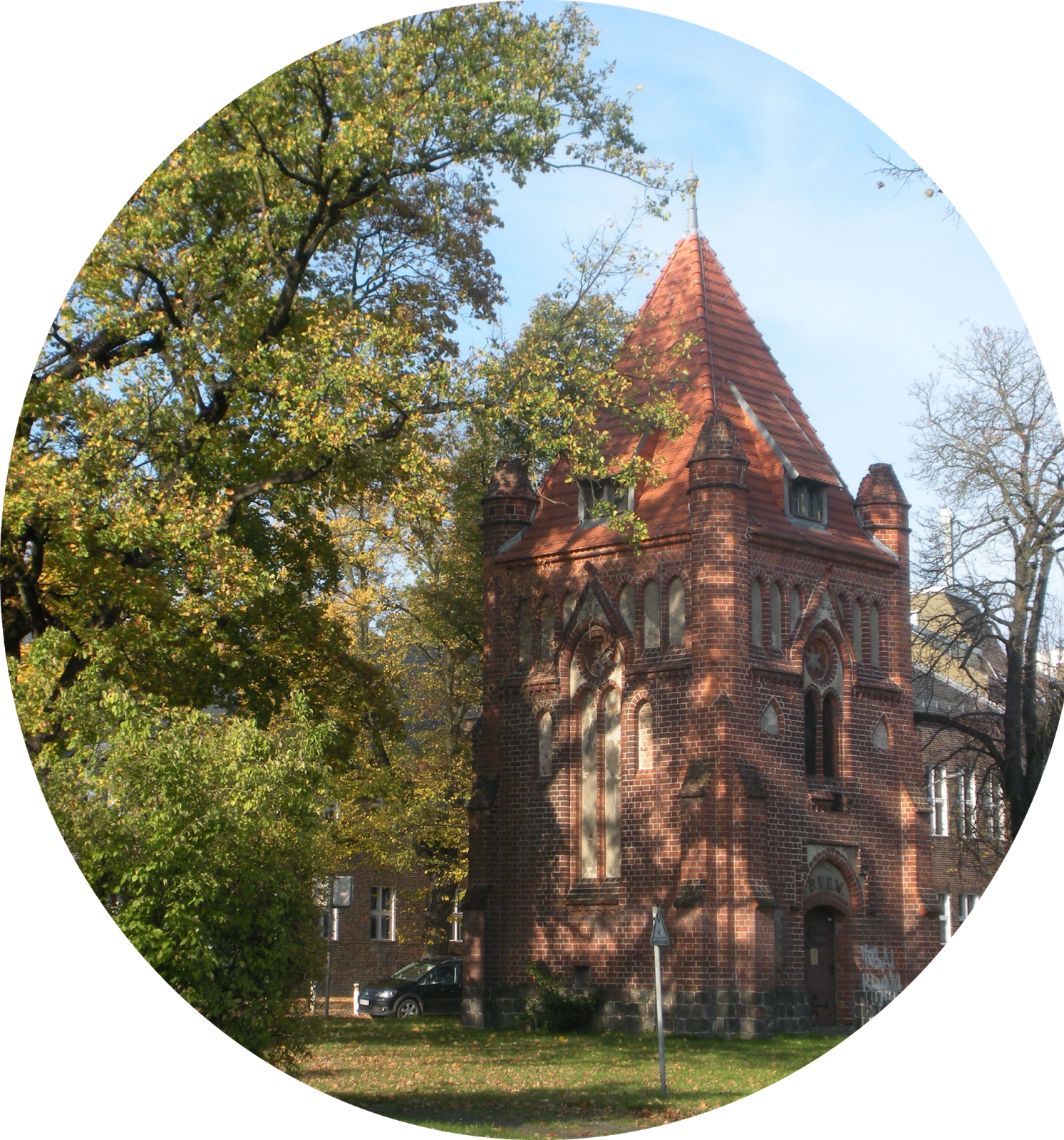
Tempelhof is so called because the Templars had a commandery here in the Middle Ages, close to the U-Bahn station where I start on this little stretch of the canal. The Tempelhof church is the biggest of the medieval village churches in Berlin, presumably because it served the Templar commandery as well as the village itself. 


Dorfkirche Tempelhof. Bundesarchiv Photo, 1940.  Wiki Commons.

Not that this is the original church (not even the one in this 1940 photo, let alone the one that is there today). The original was built about 1200 or a little before; it probably burned down, and was replaced rather promptly by another church with the same ground plan. The new one burned again almost immediately, probably during the Teltow War of 1239-45. There doesn't seem to have been much saved from the fire either time. Start over again, begin at the beginning; there's a new church (not so different from the old) in place by the end of the thirteenth century. The church survives the Thirty Year's War but hardly anything else does, here; by the war's end there is only one peasant family left alive in Tempelhof, the Teile family (and there are the Rohdes also, the local official's family). But the church is still there, and the village grows back around it, slowly: we will be passing the intersection of Teilestrasse and Rohdestrasse as we walk east. The church burns again in 1943, 1944; not much saved from the fire, again. But it is rebuilt, stone on stone, much on the same pattern as before. Here we still are, it says.

And what was the Teltow War? Not a textbook staple. But since we are here, in Tempelhof, on the Teltow plateau, let's see what this was about. 

In this war Heinrich the Illustrious, son of Dietrich the Harassed, battles against Otto the Pious and his brother Johann, grandsons of Albrecht the Bear (I am not making this up), for control over the plateaus above Berlin: the Teltow plateau to the south and the Barnim plateau to the north. [Barnim is where we were poking around last summer: see the Panke and Tegeler Fließ posts, April/May and August 2014.] Heinrich is the Margrave of Meissen (Saxony); Otto and Johann are Margraves of Brandenburg. The Brandenburgers win, passing the territory on to Johann's son, Otto-with-the-Arrow, so called because he got an arrow in the head in a battle and left it there for a long time, thinking that worse things might happen if he pulled it out. 

Otto-with-the-Arrow was a poet, as was Heinrich the Illustrious. This is the thirteenth century, rulers are no longer just thugs who whack each other with broadswords, as they would have been a century or two before. They are thugs who whack each other with broadswords and also write romantic verse. Otto's is not very good, I believe; Heinrich's is rather better. (Here is Otto playing chess with a lady, in courtly fashion, in an early fourteenth-century manuscript.) 


Otto-with-the-Arrow, Manessische Liederhandscrhift.
Photo, Wiki Commons.
These shoving matches, Saxony against Brandenburg (later Prussia), go on for centuries. (The Seven Years' War--what the US calls the French and Indian War, where George Washington gets his military experience--starts with Prussia invading Saxony.) For a long time Brandenburg-Prussia usually wins; for a long time Saxony usually has better poets (musicians, artists, scientists). Saxony has money, Brandenburg just has soldiers.

But finally, with the industrialization of Berlin in the nineteenth century, Brandenburg-Prussia finally has money; and some big tectonic plates start shifting in the political economy of the world. (What if peaceable Saxony and not militaristic Prussia had been the principal German power in the nineteenth and twentieth centuries? ask the Saxon patriots, including the one at my dinner table. Wouldn't the world have been better off?)

Archangel's family is Saxon; I think his grandfather the actor was the first to come up to Berlin, around the turn of the last century, when Berlin was finally more of a happening place than Dresden or Leipzig. (And how conscious they are of being Saxon, and how they keep the Saxon things. The gold watch that was a gift from the king of Saxony. The Meissen desk set. The painted Nativity window from the nineteenth century that Cousin T, the old Berlin mathematician, keeps in his living room: almost all that was left of the big house on the Dresden marketplace where he was a child, all that was saved from the fire.) 

Years ago, Archangel and I had to trek out to the inconvenient village in Switzerland where his grandfather had spent the last years of his life, in order to retrieve the Meissen desk set after his grandfather's last wife died. (There was rather a string of wives. The fact that the last movie he appeared in was called Every Night in a Different Bed prompts a certain amount of family hilarity.) It was a lovely summer day, the local lawyer and his wife fed us strawberries and cream in their garden, and we went through the last wife's papers. Reviews in provincial newspapers from her early acting career in Nazi Germany, mindless letters from the thirties and forties; hardly anything from more recent decades, as though nothing since had been worth saving. We had the Meissen desk set packed up for Archangel's father; the papers went into the fire.

The desk set is this sort of thing, approximately (these museum pieces are sauce-boats; but the inkwells and pen trays and such are in a similar spirit):


Meissen porcelain, ca. 1800-1850 (Porcelain Museum, Florence).
 Photo by Sailko, Wiki Commons.

You can think of Meissen porcelain, if you like, as a little hinge of economic history. In the time of Otto-with-the-Arrow, and for a couple of hundred years after, Asia was still technologically and economically superior to Europe. But one by one the Asian inventions were taken over--replicated, stolen, improved, expanded--by the West. Commercial techniques, compass, gunpowder, paper-making, printing ... But even by 1700, the West still couldn't make real hard-paste porcelain, and this was not economically trivial; the West had been shipping a small fortune in hard currency to East Asia for porcelain for a long time. 

European-made porcelain is a Saxon invention. But it's the beginning of the end of the world in which Saxony is rich and Brandenburg is poor just because Saxony has mountains full of silver mines and Brandenburg has sand dunes full of, well ... sand. It's the beginning of the world in which, if your science is good enough, you can plant massive, wealth-producing industry anywhere--here in Tempelhof, for example, where you don't have resources, but you can make your own.

**

In Berlin, at the opening of the eighteenth century, there is a pharmacist's assistant named Johann Friedrich Böttger, who is dabbling in alchemy with teenage enthusiasm, annoying his boss, who does not think it a good use of his time. When he is eighteen Böttger causes a little sensation in Berlin by making gold out of inexpensive materials. He does it multiple times, before witnesses; perhaps not in very good light. 

It's a bad moment to pull a trick like this. It's 1701, and the King of Prussia needs money--he has only just declared himself King of Prussia in addition to being Elector of Brandenburg, and being a king is a more expensive business than just being an Elector and Margrave. So the King wants to lay hands on the young gold-maker, perhaps to take advantage of the gold-making, perhaps to suppress it. (Is alchemy a righteous thing? And what a hash it would make of the money supply.) Böttger is not eager to be caught and makes a run for the Saxon border--supposedly, and perhaps really, with the intent of studying medicine at the University of Wittenberg. 

The King of Prussia wants the Saxons to hand him over: Böttger is a Prussian subject, after all. But the Elector of Saxony, who has recently got himself elected King of Poland, needs money also. (Being King of Poland is a very expensive business, worse than being King of Prussia: you have to buy the Polish electors, there are a lot of them, and they don't always stay bought.) So the Saxon authorities bring young Böttger to Dresden, in protective custody. 

And he does make gold for the Saxons, out of inexpensive materials. Not exactly as planned. 

And not by himself, of course; science is a team sport. The project really belongs to Baron von Tschirnhaus, scientific advisor at the court of Saxony. And what a pair these two are: difficult, talented, fraudulent. Out of this wrangle of wrongheads comes a small miracle.


Ehrenfried Walter von Tschirnhaus, engraving by Martin Bernigeroth.
Kupferstichkabinett, Dresden. Photo, Wiki Commons.

The Baron is one of the better mathematicians in Europe, but not as good as Newton and Leibniz and not entirely willing to believe this. He doesn't think that Newton's and Leibniz's new invention, calculus, is all it's cracked up to be. (He's wrong.) He thinks he has found a method for solving all polynomial equations. (He's wrong; Tschirnhaus tranformations provide exact solutions for cubics, not higher-order polynomials.) He tries to get a foothold in Paris, that earthly Paradise of early German scientists (Leibniz's big project in life is to find a way to stay in Paris, Alexander von Humboldt's big project in life, after American exploration, is to stay in Paris). But it doesn't work. People find errors in Tschirnhaus's math, and he tries to cover up and bluster past them, he tries to take credit for other people's work, in ways that do his reputation no good. 

He shifts attention to more technological and industrial matters. Optics, lenses, mirrors. He travels to Italy, which is a world of superior technology and fine instrument-making, and then brings what he has learned back to Saxony. He has hopes of making a fortune in instrument production and founding a natural-science academy at his estate near Görlitz, since the academies in London and Paris have not taken him in. (If you've seen the movie Grand Budapest Hotel you've seen Görlitz--at least the old department store there, which I believe served as the set for the hotel.) The economics don't work out somehow, though the Baron makes beautiful, high-quality scientific instruments (lenses, mirrors). He induces a glass furnace in Dresden to make an interesting new kind of glass and to do largely unsuccessful experiments with ceramics. (Ah, this isn't going anywhere: it's local achievement, but it's not fortune-making, it's not Paris.)

The Baron is not really a fraud. He's just trying to do very difficult things and cannot always do them, and cannot always even tell whether he has done them or not. (Actually, as someone finally proved in the nineteenth century, Tschirnhaus transformations do work pretty well to approximate solutions to higher-degree polynomials, even if they don't provide exact solutions; and this is not such a trivial accomplishment.)

Böttger is not entirely a fraud either; in his way, he is a very talented experimental chemist. But his attempts to make gold with the Saxons are going nowhere, and in 1703 he flees to Austria. The Austrians politely extradite him, and King Augustus of Saxony (who is not having a good time with his Polish venture, and is annoyed) locks him up in Königstein, which was the standard Saxon lock-up spot from medieval times until the mid-twentieth century (POW camp in the world wars, juvenile detention center afterward). Fifty years after Böttger's time here, when King Augustus has made Dresden one of the most beautiful cities in Europe, Canaletto comes from Venice to paint Dresden, and makes some detours into the countryside, as we see here:

Canaletto, Königstein Fortress. National Gallery of Art.
Photo, Wiki commons.

Baron Tschirnhaus has an idea, however, after his glass project loses traction. Maybe we can make porcelain, like the Chinese. Not stoneware, not faience, such as Europe can already make; but real, hard-paste porcelain--translucent, tough, worth its weight in gold. Saxony has a good supply of minerals (including the key ingredient, kaolin), and Saxon metallurgy is probably the most advanced in Europe. Tschirnhaus's concave mirrors will help to bring glass-furnace temperatures up to the 2500 degrees F. needed to fire porcelain, and the Saxon metallurgists will make furnaces that will stand up to this heat for extended periods. (Can anyone else in Europe do this? Perhaps not.) We just need to get the mixture of materials right. No one outside of East Asia knows what the right mix is; but there is an excellent experimental chemist going to waste in Königstein Fortress.

So Böttger is brought back to Dresden for a bit, and then set up in a quasi-secret lab in the Albrechtsburg in Meissen, the ancestral castle of the rulers of Saxony. (King Augustus, who likes Italian Baroque, doesn't care for it.) There are two other labs going simultaneously, one in Dresden under Tschirnhaus and one in Freiberg (the mining-technology center), each working out its own set of problems. (The Freiberg people deal with furnace-building.) Everyone is being paid well except Böttger, who, as a prisoner of the King, is not being paid anything.

Albrechtsburg, Meissen. Photo, Adam Kumiszcza, Wiki Commons.
But then the King's Polish adventure goes sour. He has been trying to get a firmer hold on Poland by evicting the Swedes from the substantial section of the south shore of the Baltic which they hold. The Swedes, however, strike back, evict Augustus, install a Polish king of their own, and keep coming. In 1706 they plunder Saxony like Vikings.

Tschirnhaus is ruined; his property is in the path of the Swedes. The porcelain team flees to Königstein (prisons and refuges are hardly distinguishable, in hard times) and cannot resume work until 1707, when the Swedes leave. (The Swedes are heading east to conquer Russia, where they will have the usual success that such projects have had.) The porcelain team moves back to Dresden in September of that year, and by mid-January, one of Böttger's experiments yields the first true European hard-paste porcelain. 

The King rushes them to start large-scale production and names Tschirnhaus as head of the new manufactory. (it is to be at Meissen: technical secrets better protected there, in the old fortress, than in the more public and porous world of Dresden.) But there are substantial technical problems still to be solved, especially with glazing, and perhaps they are insoluble; Tschirnhaus is afraid of falling into a trap and says, no, wait, don't give me any titles until we're sure we can actually produce. 

But in a few more months Tschirnhaus is dead, fallen victim to a passing infection. He is no longer young; what he has wanted in life--to live in Paris where science is really happening, to be a great mathematician, to make a fortune--has never happened.

Böttger solves the remaining technical problems quickly and is put in charge of the manufactory in Meissen, which is soon up and running and coining money for King Augustus. Böttger is still a prisoner; technically, he will be released in 1714, but he will never be allowed to leave Saxony. In a few more years he too will be dead, at 37, accidentally poisoned by the materials of an experiment. And what had he wanted in life? On the one hand a really good lab, perhaps, and on the other hand, freedom. But the two never went together.

**

So many of these things end badly. The Templar commandery here is a reminder that the medieval courtly poets and their verse end badly also, in a way. The Templar order is founded to protect pilgrims to Jerusalem, after the conquests of the (somewhat backwoodsy) Seljuk Turks have unsettled the civilized Middle East, and the responding Crusades from the West have unsettled it more. The courtly-love poetry of Heinrich the Illustrious and the rest, which owes something to the courtly-love poetry of the Islamic world, grew out of a time of of more civil East-West relations. 

Love had mostly not been so romantic in Greece and Rome. In the classical western world, love was an itch that needed to be scratched; it didn't have high moral implications. In Roman literature there is great poetry of sexual obsession (Catullus) and sexual gamesmanship (Ovid); there is great poetry of renouncing scratching in order to do your civic duty (Virgil); but there isn't exactly romance.

Arabic literature contributes to notions of romantic love as something exalted, humanly (even morally) valuable, even if it's unrequited. The love-poetry conventions of the medieval West appear early in Provence, which gets them from Muslim Spain, which got them from Perso-Arabic courtly poetry. Raimbaut de Vaqueiras, a Provencal troubador, says, Love makes the best man better, and lends value even to the worst.  

Love may make the best man better, as Raimbaut said, but crusading tended not to. Raimbaut and his lord were killed in the process of plundering (Christian) Byzantine territory in the Fourth Crusade. (The Crusaders had turned aside to loot Constantinople, on the grounds that it was very rich and eminently lootable.)

The German poets had mixed feelings about the crusades. Friedrich von Hausen wrote, "My heart and body have gone together for a long time, but now they want to split up. My body wants to go and fight the heathen, but my heart has chosen a lady ..."  He was killed in a battle in Syria. Walther von der Vogelweide, perhaps the greatest of the German medieval poets, called on to provide PR for a late, inglorious, politically manipulative crusade, captures the uneasy feelings as the period goes rancid:

    Where have all my years vanished?...
    Country and people that I grew up with, 
    Everything is strange to me, as if it were all a lie. 
    My childhood companions are aging and apathetic, 
    The green meadow has been plowed up and the greenwood cut down. 
    Yes, if the water didn't flow any more as it used to flow, 
    My unhappiness would be too great.

So the best thing to do, Walther concludes, is to go on crusade. Get out, go bash someone overseas. 

**

Heinrich the Illustrious, the poet and the loser in the Teltow war, had a brief taste of crusading--not in the Middle East but against the (pagan, non-Germanic) Prussians--but he didn't repeat it. When he was quite young he tried to take a Prussian fortress near what is now Kaliningrad, in Russia, but failed. A few years later, a different set of Germans succeeded, with support from the brother-in-law of Heinrich's enemies, the Margraves Johann and Otto of Brandenburg. (Eventually, centuries later, the territory around this fortress would fall completely into Brandenburg hands. This was the Prussia in which the Margraves of Brandenburg eventually became Kings.)

Things ended badly for Heinrich: he won territory and lost it; there were family troubles, war among his sons, the oldest of whom is known to history as Albrecht the Degenerate. But here Heinrich appears as he might have in better times, even a little further cleaned up for 1900-ish taste, in the Dresden Princes' Procession. This is a hundred-yard long representation of Saxon rulers from 1127 to 1904, all done in Meissen porcelain tiles, along an outer wall of the Dresden palace complex.  

Heinrich the Illustrious, from the Princes' Procession in Dresden. Photo, Wiki Commons.

Much of the palace complex is recent reconstruction, but the Princes' Procession is the original; it came through the firestorm of the Dresden bombing without much harm. Hey, it's porcelain, it's been fired already.

**

Here along the edge of Tempelhof, as Walther von der Vogelweide would have said, the green meadow has been plowed up and the greenwood cut down; and these days, not even the waters flow as they used to. The Tempelhof church was originally set between four little lakes, only two of which remain. There used to be another of these kettle lakes--dead-ice lakes, one says in German, made when the retreating glaciers left a block of ice behind--down at the bottom of Franckepark, the next in the chain of pleasant parks that starts by the Templar church. Most of the Franckepark lake disappeared when the construction of the Teltowkanal drained water out of the neighborhoods. (Though who knows, it may come back. The water table is rising again in Berlin, as less water is pumped out for the city systems: the thirsty old heavy industry has been replaced by things like media firms and software developers and government offices that don't do much with water except fill their coffee machines and flush their low-flow toilets.) 

There's a little deer park in the hollow where the kettle lake in Franckepark used to be. (Deer are not such suburban vermin in Germany as in the US, I think; it is still thought charming to see them in parks.)


Deer in Franckepark, December 2014. My photo.
  
There are two big industrial streets along here past the deer park. One is Oberlandstrasse, where the UFA film studios were (think movies like Metropolis and Blue Angel, and rafts of forgettables like the ones that Archangel's grandfather played in). There were German television studios and archives still here until fairly recently, but they seem to have moved away after a disastrous fire in 1999 took out the archives (nothing saved, to speak of; irreplaceable losses of older video footage). 

The other big industrial street, which is part of my close-to-the-canal route, is Teilestrasse (named for the tough local folks who survived the Thirty Years' War in Tempelhof). The buildings that front on Teilestrasse also back on the Teltowkanal, and you can't actually get down to the water. Even the Teilestrasse fronts are not always so accessible: lots of wall and fence along here, grown up wild in silver lace vine:
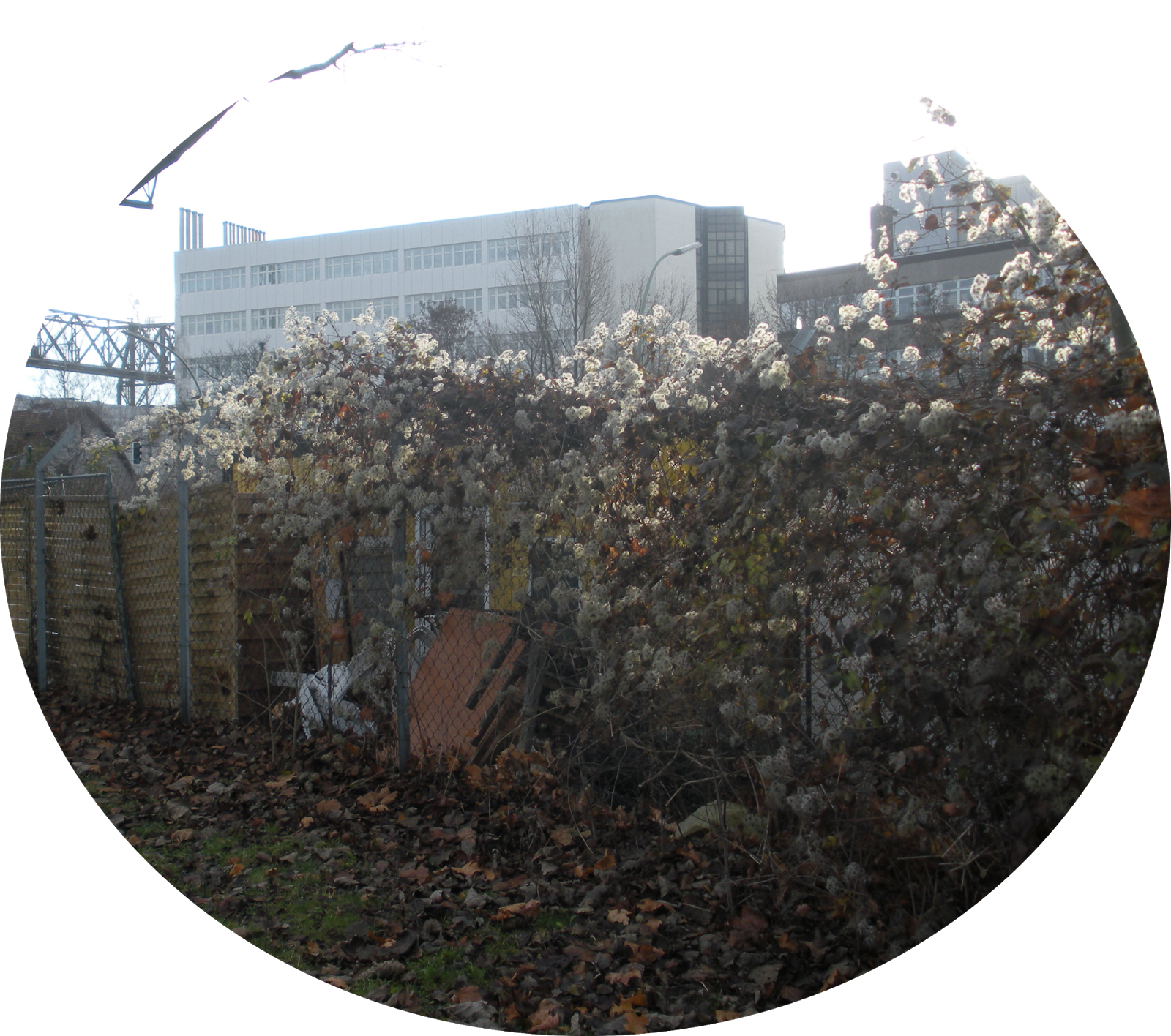

Along Teilestrasse, December 2014. My photo.

Not all these buildings are occupied now, though some of them are flourishing. Building materials, metal-bending work, that sort of thing. In the length of Teilestrasse I meet exactly one other woman, everyone else on the street is male, mostly of the big-guy-in-blue-overall type.

Somewhere back along this stretch of the canal and Teilestrasse is an enormous chocolate factory, built just before World War I. That is, the original was built then; it burnt down in a spectacular blaze in 1922 that lasted three days and two nights and left nothing. What a truly terrible time to lose your plant, even if it was adequately insured: hyperinflation is just taking off, the French are about to occupy the main industrial district in Germany, resulting in a general strike, and how can you get foreign exchange to pay for your raw materials when the German currency is essentially worthless? By late 1923 the exchange rate is four trillion marks to a dollar. But by late 1923 the new factory is also up and running, on the ashes of the old along the Teltowkanal. Ach, the persistence, the work, the force of character ... The heroism of managers is underrated. And then in another twenty years the place burns again, though only partially this time. What may be worse in 1945 is that the raw material inventory and much of the machinery are taken away by the occupying forces. But by the late forties the plant is running again. We are still here, as the Teile family might have said. Now the building waits for new renters, since the chocolate production was consolidated in a plant a couple of neighborhoods to the south--the village that was the last outpost of the Templar commandery, as it happens.

**

And then there is the great object on Teilestrasse, the gantry crane of the United Berlin Coal Dealers (Vaubeka, die Vereinigte Berliner Kohlenhändler). What a fantastic thing this is, a crouching animal along the wintry street:


Vaubeka crane, Teilestrasse, December 2014. My photo.

Then we come to a bit of a park under a freeway ramp, and then back to the water at last, at Tempelhofer Weg. There's a fine industrial view back along the canal to the west:


Along Teltowkanal at Tempelhofer Weg, December 2014. My photo.

... and here is the water at last, the canal looking much like itself again, to the east of the bridge.


Teltowkanal at Tempelhofer Weg, December 2015. My photo.

And here's a very decent sort of footpath along the south bank, in a little park strip where the winter trees show their structure. 


Tree along Teltowkanal, December 2014. My photo.

But mein Gott, what is that smell that has been in the air ever since the bridge and becomes more intense as we go along here? It is something like scorched, rotting coffee grounds. Bad coffee gone bad, so to speak. Possibly it is time to head for the transit and go home.

***

Information on Tschirnhaus (also called Tschirnhausen) transformations from  http://mathworld.wolfram.com/TschirnhausenTransformation.html

Other sources: German Wikipedia articles on Böttger, Tschirnhaus, Tempelhof, Oberlandstrasse, Teilestrasse.

Thursday, December 25, 2014

Teltowkanal 4

Winter greens, safe harbors

Here is the winter at last. Fine sunsets come at half past three. (Oh, the sun sets later than that, officially, but the twilight starts practically after lunch at this latitude.) Hours later, in the long dark, the wind and sleet bang on the outside of the bedroom wall. The winter isn't serious here, not yet, the snow won't stick; but the inside of a well-warmed featherbed is a good place to be.

Late-afternoon view from living room. My photo.

Most days the clouds trail in the streets, gray and close, almost scraping the pavement. But one day when I get up in the black morning, I can see the moon burning like a fat candle in the sky over the bend of the Spree. A clear day coming! 

I go out about nine in the morning, when the eastern sky is still yellow from the sunrise--and how bright the day is, sunny as can be, with scarfy bits of white cloud appearing and dissolving in the astonishing blue to the west. Rain in the night has washed all the auto exhaust out of the air and it is fresh and mild--at least, above freezing. Fine walking weather.

In the US people go out in the winter to do something particular and vigorous, like skiing, but I don't think they like the winter fresh air in general, in the way that Germans do. Archangel has a running battle with one of his assistants who wants to fling the office windows open every day of the year. We have friends here who sleep with their bedroom skylight open all year round and think it's amusing to wake with a layer of snow on their bedcovers, if the wind has been in the right direction to drive the snow through the tilted-open skylight. 

And people do eat and drink outdoors here through much of the winter. As the autumn fades, big red blankets appear over the chairs at the cafe tables, so that people can huddle in comfort over a sandwich and a coffee, or a not-too-cold beer or a bowl of soup, when it's only a few degrees above freezing. 

Now, of course, people are outdoors en masse at the Advent markets, shopping for trinkets and guzzling hot spiced wine and eating gingerbread or roast chestnuts or sausages. All these things taste better in the outdoor cold than they would otherwise. (I have never mastered the technique of outdoor sausage-eating, however, I always end up with mustard on my coat-sleeve.)


Christmas market, Breitscheidplatz, Berlin, November 2013. Photo, Arild Vagen, Wiki Commons.

I am not so good at the technique of getting out the door in the morning with everything I meant to take, either. When I am on the S-Bahn on the way to the Teltowkanal I realize that I have left my maps behind. Maybe the cat had settled on them. 
    
    The cat sat on the maps 
                          (perhaps).

Agh. But this is such a straightforward stretch I hardly need a map with me, I think. Just take the S-Bahn south, walk about half a mile farther south from the relevant station to get to the canal, and head eastwards along the near bank. 

And this works, sort of. My first choice of a southbound street isn't right, it angles off to the east after a little bit. Then the first southerly cross-street dead-ends in an unpromising way. The second southerly cross-street also dead-ends--and is this even southerly any more, Ms. Misdirection? Ah, but let us examine this dead-end more closely. There's a set of stairs going downward between the houses, and ... Yes, definitely, this is the way to go. Follow your nose. I can smell the wet leaves ahead, the masses of wet leaves that must lie along the canal and not up here among the houses. Here is the water.


Teltowkanal near Südende, December 2014. My photo.

How low the sun is, shining horizontally from the edge of the sky in midmorning. And how much green there is still at this time of year. Ivy, mahonia, boxwood, creeper, the occasional rhododendron, all still have their leaves.

**

There are small harbors along the canal here. Mariendorf harbor, which used to handle fuel before the Mariendorf gasworks closed and was replaced by the biggest solar-power facility in Berlin. Lankwitz harbor, where heating oil comes in and is stored and redistributed.

The oil tanks sleep placidly in the sun, on and on along the water. Like fat white candles or fat white cocoons.


Oil tanks along Teltowkanal, December 2014. My photo.

Somewhere around here, as we walk east, we are changing neighborhoods. We've been in Steglitz on the north bank of the canal, where the path is, looking across to Lankwitz on the south. Now it's Tempelhof on the north bank and Mariendorf on the south. Little natural waterways have been absorbed into the canal: the Lanke brook that gave Lankwitz its name, then the chain of pools--glacial meltwater along the edge of a moraine--that formed the medieval boundary between Tempelhof and Mariendorf.

Here is the first street bridge we come to in Tempelhof. Built about 1905, Art-nouveau time, when all the architectural ornament turned to flowers and leafage. Blown up in 1945, rebuilt a few years later. 


Teubertbrücke on Teltowkanal, December 2014. My photo.

There are Christmas decorations, corny and otherwise, on the balconies of the apartments along the way.

Along the Teltowkanal, December 2014. My photo.

The canal lies far below street-level. Long stairways run down the canal bank from the residential streets to the water, in case you should want to step down from your apartment to catch a boat, catch a fish ... 


Along Teltowkanal in Tempelhof, December 2014. My photo.

And then suddenly we're at Tempelhof Harbor, and everything is different. The city is a book and the page has just turned. (
How wonderful it is to leaf through the book, say from the upper deck of a bus on one of those routes that arc through the city along improbable lines (east here and south there, and why have we suddenly turned down this street?). And wonderful too, of course, to go paragraph by paragraph, street by street, on foot. Densely written pages here, almost every one different. US cities are not quite like this: the pages are less written-on, more alike; sometimes, as it were, stuck together with spilled Coke and french-fry grease.) Though the pages are about to be stuck together here, too: there's a stretch east of the harbor where we can't get close to the water and will have to trudge along some streets that don't look very promising. But meanwhile, there is the harbor ....

Tempelhof Harbor used to look like this (it still does sort of, but not quite): 

Tempelhof Harbor, 2006. Photo, IHenseke, Wiki Commons.

There's Ullsteinhaus with its clock tower in the lower left of the picture, and a big warehouse-clump with the red roofs on the other side of the harbor. The city as a book, books in the city: Ullstein is a pubisher, now broken up and moved.  

Do you remember how it feels, the first time you can really read another language--not just plod along with a dictionary, but understand, glide through the looking-glass into an alternative world? (Life in other languages, like life on other planets.) I think the first full-length German novel I ever read was an Ullstein book; not anything particularly good, but I remember the Ullstein owl logo happily. And the fish logo on Fischer books and the sailing ship on Insel books (on my somewhat kicked-around Rilke paperbacks, on my father-in-law's incredibly battered, beautiful Rilke hardcovers from the 1920s--did he take the Sonnets to Orpheus with him to Lisbon and New York when he fled, in 1938, or did he recover them after the war? I don't know.)

One of the new-language-world pleasures is the pleasure of getting to know new publishers. Pleasant memories come to mind, of rooming with a French major, admiring the beautiful Pleiade editions, or feeling the thick coarse paper of the books where you still had to cut the pages yourself--and the books didn't come with hard covers because if you were a proper bourgeois you had the books bound yourself, in a style suitable to your library. I don't know if French books still come this way ...  It's certainly not the case any more, as it used to be, that German bookstores are organized by publisher rather than by subject matter and author. German bookstores used to have one section of shelves for the Ullstein books, one section for Rowohlt, one section for Fischer, and so on; and you sort of knew what you would find in each place. 

German bookstores don't do this any more--although the Reclam books are usually off by themselves still, probably just because they're so small that they need a different size of shelves. Reclams are wonderful little yellow paperbacks of the German classics, that used to cost next to nothing and fit even in a very small pocket, perfect for walks. (And the Reclam books have held up surprisingly well; so many of my paperbacks from the 1970s are falling apart, but the Reclams are not. The corners have sort of rubbed off Hölderlin's Gedichte, which is a book that has had a lot of use; but it is still reliable company on the S-Bahn, the pages will not fall out. O drink the airs of morning! and name what is before your face, says Hölderlin, as the express trains blow past.) 

The Ullstein owl still perches over the entrance of the building, which now houses a disco, a bank call center, and various other operations.


Owl, Ullsteinhaus. Photo, Dirk Ingo Franke, Wiki Commons.

The midcentury troubles of central Europe lurk a bit around here. The Ullsteins were Jews, the firm was "Aryanized" and the building renamed "Deutsches Haus" in the 30s. The Ullsteins got the company back after the war, but didn't keep it very long; it was gradually sold off to Springer and other firms. 

Also, we aren't so far from Tempelhof field here, where supplies were flown in during the 1948-49 blockade, when the Soviet Union cut off all the roads, railways, and waterways into West Berlin. No food, no fuel, no medications, no anything coming in without the airlift. A cargo plane every three minutes, half an hour on the ground to unload, back again in the air, thousands of tons a day, hardly enough for the city to live on. The warehouses at Tempelhof Harbor were one of the redistribution points for the airlifted supplies.

Tempelhof Harbor, warehouses, December 2014. My photo.

From the end of the 1940s until the 90s, these warehouses were also one of the places where the so-called Senate Reserves were stored. The Reserves were a six-month supply of coal, food, medications, and other daily necessities, sufficient to keep the city going in case of another blockade.

The list of what was kept in the Senate Reserves is curious. Of course there was coal, gasoline, grain, canned foods in great quantity. Also:

            96 tons of mustard
            380 tons of rubber soles and heels for shoe repair
            18 million rolls of toilet paper
            25.8 million cigars [surely we could manage without these?]
            10,000 chamber pots 
            5,000 bicycles
            19 live cows

The Senate Reserves are long gone, of course. After the Wall came down, the coal stockpile went to the power plants bit by bit, in the normal course of events. The food and medications were donated as aid to the Soviet Union.

Ah, but what to do with the storage buildings, like the big warehouse at Tempelhof?  Major renovation in recent years: offices, shopping center, bits of new building, not all of it attractive. Near the shopping-center entrance is a low building covered with thin metal plates pierced in seagull-shapes, which you can see if the light is right.


At Tempelhofer Hafen, December 2014. My photo.

The light is not so generous at this season, even on a day as bright as today. As you walk up into the neighborhood on the north bank of the canal, you see streets--broad enough streets, two lanes of traffic and a line of parked cars on each side--where the sunlight doesn't come for weeks (months?) in the winter. The sun is too low, even on this bright noon: the house-shadows lie over the streets all day, every day.  It's only if you face south over a big open space that you get the light ..


On Wenkebachstrasse, Tempelhof, December 2014. My photo.

How tremendous the vine is that rambles over the lower stories of this house, greening in the sun. ... And across the street, the light is generous at the end of the big hospital complex that stands here:


Hospital, Wenkebachstrasse, December 2014. My photo.

Other parts of the complex lie more in the winter dimness; this end is the hospice. Sunlight for the dying, on the days when the sunlight comes. 


Sunday, December 7, 2014

Teltowkanal 3

The Light Goes Away

The last time I was on this stretch of the canal was a late-December afternoon a few years ago. I was in Lichterfelde, in mid-south Berlin, for some now-forgotten reason, and I came to the canal and thought it would be interesting to follow the water westward. It looked fine on the map (a sentence which suggests bad things are about to happen).

What happens in this stretch of the canal is that you're locked into the path for a longish way. On one side of the path is the water, with no bridges, and on the other side is high fence, guarding hostile establishments that (through the fence, on a dim winter afternoon) look like junkyards, complete with junkyard dogs. The establishments are actually things like recycling-processing centers and body shops (complete with recycling and body-shop dogs, who are no more mellow than their junkyard colleagues). 

I was just in Berlin for a Christmas visit that time, and, having been in Michigan until a couple of days before, I had forgotten how lightless the winter afternoons are here. It's not that it really starts to get dark before three--the sky is the same pale pewter color all day until four or so, it isn't black. But it's as if someone's taken the light out of the day, someone's shoved the dimmer switch all the way down, you see things indistinctly in the dimness. 

I was still trapped between the junkyards and the water when it started to get really dark. An occasional homeward-bound bicyclist bounced past, headlamp reflecting on the fluorescent-painted rocks and roots in the path, marked so that cyclists wouldn't hit them too fast in the dark and go tail over teakettle into the canal. On the map, it looked as though you could probably get off the path and into the streets where transit was available, but actually you were stuck between water and fence, without a very good idea of whether the nearest exit was ahead or behind. 

The remains of the day got dimmer and dimmer, and it was more and more solitary. The path ran through a strange doorway from nowhere to nowhere--so what happens if I go through the doorway? It takes me into some sort of body-snatcher realm? Nah, just more path, full of roots and rocks painted day-glo lemon and chartreuse and magenta, with the black water on one side and the high solid fences on the other. I didn't find a way off the path until I was almost in Kleinmachnow [see Teltowkanal 2 post] and it really was dark. 

But it all looks different on a bright mild afternoon. (I walked this little stretch of the canal from west to east at the end of October, before getting sidetracked by the Prague trip and stacks of work to do; hence this delayed post.) The bank rises enough on the junkyard side that the path is very sheltered, and on a sunny day it was warm as summer here, although it was coat-and-hat weather up in the city, beyond the recycling places and body shops.
Teltowkanal near Teltower Damm, October 2014. My photo.

The fluorescent paint on the roots and rocks had worn off and not been replaced, though also I think the path had been upgraded since the last time I was here--there are not so many hazards now for the fast-moving cyclist.

The doorway in the woods was still there, still slightly unnerving even in the October sunlight. 
Doorway along the Teltowkanal, October 2014. My photo.
It's strange and ruinous, a way through a wall that doesn't exist any more, a doorway standing there without a function and therefore looking as though it ought to have a meaning. (It made me think of an abandoned town I came across once out on the Colorado plains: the houses were gone, the streets were gone, and all that was left, besides a crumbling schoolhouse wall, was a set of fire hydrants lost in the dry grass that hissed and rattled in the wind. How ruins affect us--even a ruined fire hydrant is a dreamy, melancholy thing.)

**

The overgrown solitude here is a fine thing on a sunny late fall day. Here's the footbridge over the Stichkanal--a side branch of the canal, like an exit off a freeway, that the water traffic once took into the industrial district to the north.

Footbridge, Zehlendorfer Stichkanal, October 2014. My photo.
There was a big Zeiss camera plant here, and a Telefunken plant (telegraph and radio equipment) before the Second World War. Then there was a big US Army establishment here after the war. Some industrial and commercial stuff still exists up along the Stichkanal, but it depends on truck not barge transport now, so the little side waterway is drifting back to nature.

The path has definitely been upgraded ...


Along the Teltowkanal, October 2014. My photo.

On the other side of the water, after a bit, is the fine sculptural mass of the Lichterfelde power plant. I do love power plants. We can see three of them from the windows of our apartment, and they serve as useful weather indicators--for example, it looks clear out there this morning, but you can't see the Reuter plant in the west at all, so there's moisture gathering. It's going to rain before the end of the day. (Our apartment is on the wrong side of the building to have the "good view" the neighborhood offers, over the immense tree-fleece of Tiergarten, with Gold-Else the angel floating above the trees on the Victory Column on one end of the park, and the jagged glassy mass of the Potsdamer Platz buildings at the other end. Instead we see power plants and harbor facilities and jumbles of housing; distant woods and a nearby jail and the rail lines with their little bright trains going past twelve stories down. It's like having a tremendous model railroad set, with the square-nosed red-and-yellow S-Bahns going by every couple of minutes, and the green-and-silver ODEGs (the Ostdeutsche Eisenbahn Gesellschaft, the East German Railroad company, which I believe is half owned by the Italian state railroad and runs very well), and the big red double-decker regionals screeching their brakes on the Bellevue curve, on their way to Frankfurt-an-der-Oder or Brandenburg-an-der-Havel or who knows where.)

Lichterfelde power plant, October 2014. My photo.

I am not the only person who finds the Berlin power plants handsome and poetic. The Lichterfelde plant was on a German postage stamp once, in a very muscular, stylized representation, and here is someone else's romantic photo of the plant. (And no, the cooling towers don't mean it's a nuclear plant; it's natural-gas-fired cogeneration.)


Lichterfelde power plant. Photo, Claas Augner, Wiki Commons. 

There's a small industrial harbor by the plant, and then we're back in the woods for a bit. (How long the leaves stay green here. Now, as I write, in the first week of December, the willows are still half-green along the Spree, although most of the other leaves have fallen.)
Teltowkanal near Lichterfelde Harbor, October 2014. My photo.

Then there's a crossroad sign along the path saying that Schlosspark Lichterfelde is off to the left--so perhaps this is the place to leave the water and look for transit home. 

The bus stop is by the old village green in Lichterfelde. This is not the village church in the picture, however, it's something like an electrical substation.


Lichterfelde Dorfanger, October 2014. My photo.
**

That was the last of the sunny days. I came back about two weeks later to do another short stretch of the canal, starting where I had left off, at Schlosspark 
Lichterfelde. 

So here we go down the garden path to the water in the gray November day (already there's less light, already the city is pulling back into itself in the dimness, getting ready to wait out the winter).
Schlosspark Lichterfelde, November 2014. My photo.

A friend who has lived all over the world says: There are three ways you can have seasons: hot and cold (continental climates like mid-America), wet and dry (parts of Asia and Africa), or light and dark (northern Europe). It's tempting to imagine that these different ways of experiencing the year give people different inner lives and make for different societies. (Oh, let's not get too deep into geographic determinism here. But still ... would southern California have the character it does if it had the climate of Buffalo, New York. Nah, I doubt it.)

Summer as endless heat is one thing, summer as endless light and a lot of 65 degrees F. is something else. And similarly, winter as three feet of snow and temperatures that will remove the more salient parts of your face is something different from this mild withdrawal into dimness. The tourists I pass in a December mid-afternoon, on my way to pick up groceries, are holding their maps up to their faces, struggling to read them in the daylight. The daylight is there, but it just doesn't amount to much, muffled by the endless trailing street-level cloud of early winter. 

**
It isn't beautiful here, exactly, along the canal. But it's very Berlin, this mix of green space and imposing industrial plant gone a bit scruffy, wrapped in November mists.


These gaunt brick buildings have a kind of unbeautiful distinction--unbeautiful like distinguished long-faced 1930-ish Englishwomen: think of Edith Sitwell, think of Viriginia Woolf and her sister. Horse-faces, one and all.


Along Teltowkanal, November 2014. My photo.


Bust of V. Woolf, Tavistock Square, London. Photo, Stu's Images, WikiCommons.

We're getting out of Lichterfelde, which is worth a good deal more exploration than it's getting on this trip. Lichterfelde, like a number of other sub-districts down in these parts, was a Rittergut--a manor--until the latter part of the nineteenth century. Then an entrepreneur got a good deal on the property from the lord of the manor (who was sinking under his debts) and developed it as a big-house neighborhood for high-level civil servants and military officers.

Ah, the silly houses these people built. They displaced the lord of the manor and wanted to live in castles. 
Villa by Gustav Lilienthal, Lichterfelde. Photo, Wiki Commons.
Actually, this one is moderate enough; it's one of the "Lilienthal castles" in Lichterfelde. Good Gustav Lilienthal--one of those turn-of-the-last-century utopians who made some money on big-villa commissions for the rich but spent a lot of time developing better housing for mid- to lower-income people. These Lichterfelde castles were meant for folks with moderate income. Lilienthal also founded a housing co-op for the non-rich (Free Soil, the enormous co-op that backs on the Tegeler Fließ), developed low-cost construction methods to provide solid buildings for a vegetarian colony and a church-based settlement for the homeless and handicapped north of Berlin. He created educational toys and helped brother Otto develop flying machines. (Otto built a hill--an unnatural object in table-flat Lichterfelde--to fly from. Otto eventually crashed, but the aerodynamic principles he worked out were what the Wright brothers used later. The settlement for the homeless and handicapped managed to hold off the euthanizing Nazis and nationalizing Communists and go its own way in peace, decade after decade. For a few months in 1990 it took in Eric Honecker, the ex-head of the East German state, who had lost his job and his Party housing and found he couldn't live anywhere without being driven out by hostile demonstrators.) 

Upright, determined people who went their own way, the Lilienthals and their friends. Gustav's daughter Olga and her husband Gerhard stuck with Jewish friends in the 1930s and made public protests against Nazi policies; Gerhard lost his job; later he refused military service and was lucky to live to tell the tale. When the Russian army came through at the end of the war, killing and plundering, Gerhard took a chance and played welcoming host to the soldiers that burst into the house, trying to get them drunk fast enough that unconsciousness would win the race against rising violence. Sort of worked; everyone lived to tell the tale. Olga told it to Archangel, at any rate, when he stayed with her for a few days in the house in the 70s, on a research trip. It was one of old Gustav's castles, of course.

We're getting out of Lichterfelde and into the next sub-district, Steglitz. There are still handsome compositions of autumn and industry:
Along Teltowkanal near Hannemannbrücke, November 2014. My photo.

There are terraces here and there along the water, buried in fallen leaves.


Along Teltowkanal, November 2014. My photo.

It will be a while before the winter cold, such as it is here, really comes. The geraniums are still in full bloom on the balconies, and may be until Christmas, if we're lucky.


In Steglitz, near Teltowkanal, November 2014. My photo.