Tuesday, June 14, 2016

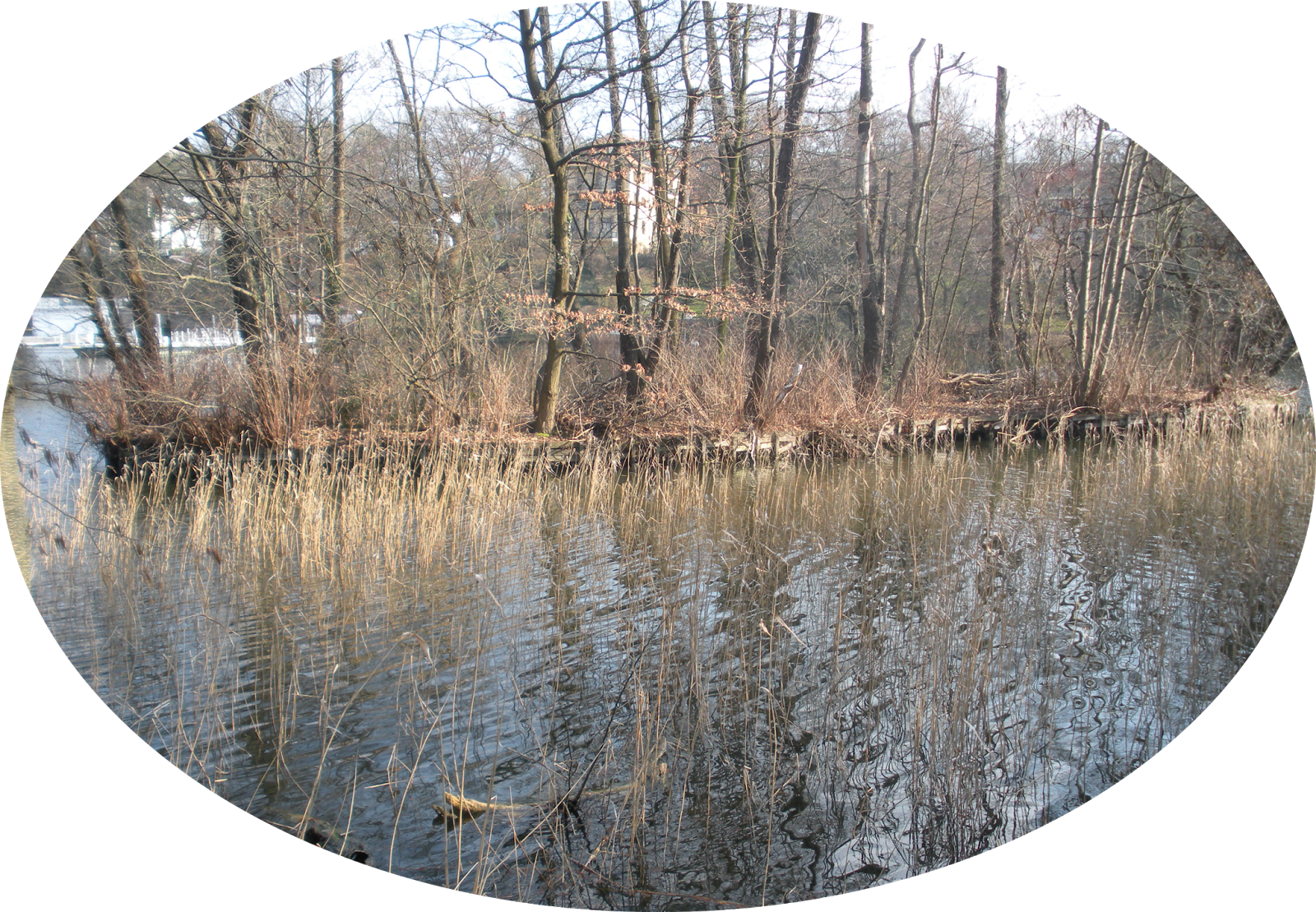
Grunewald Lakes 5


Summer, feast of light. According to the almanac, nautical twilight, when there's still a little light on the water, changes to full night at almost midnight; and the first semi-light--when the birds start racketing in the trees under our bedroom--comes back at half past two. 

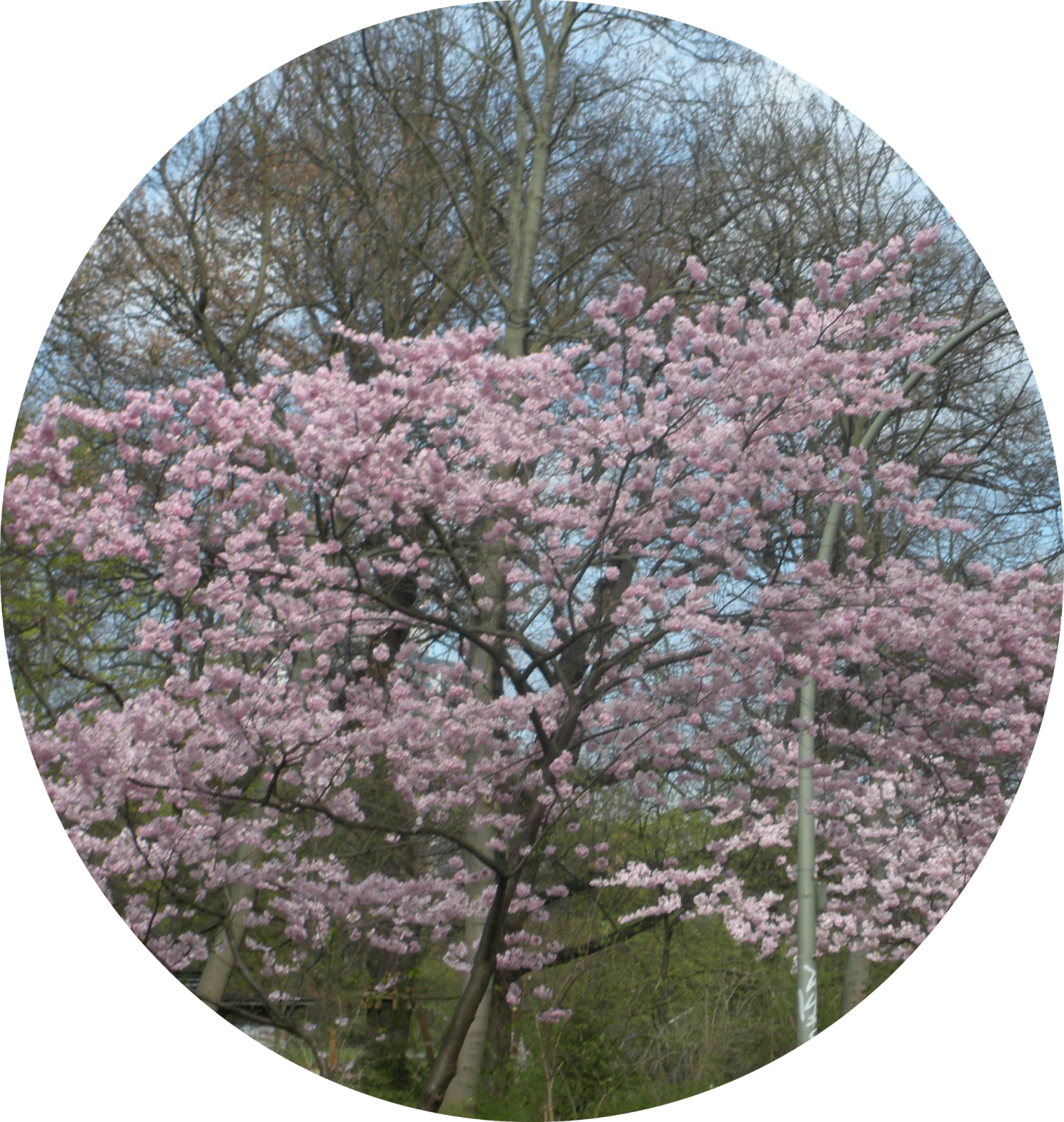
The (huge) windows are open all day; the apartment (stone floors, open space) feels like outdoors. In May, when I threw the windows open first thing in the morning, the apple-blossom fragrance would come rushing into the room from a dozen floors down; and one day I found that a storm wind had blown petals all the way up to our level, so that the edge of the bedroom (in this no-windowscreen world) was scattered with pink apple-blossom.  It is June now; soon there will be linden-blossom scent, stronger and sweeter, summer-deep.

So here we are at the last couple of Grunewald lakes. Back to Uncle-Tom Street [see last post] and into the wetland of the Riemeisterfenn. Down we go into the glacial valley, in the green-gold light of an early summer morning. 


Stairs down to Riemeisterfenn.  May 2016, my photo.

Oh, I'm such a sucker for this. I love the woods. Does anybody else remember particular trees they knew in grade school? Particular trees from everywhere they've lived?

Here we come down to a lower-level path--and there's always a joker in the crowd, of course. Someone's decorated a stump down here.


Stump, Riemeisterfenn.  May 2016, my photo.

Almost everything that flowers in the woods now is white, as white as light. There are chestnuts blooming here and there, sometimes standing at the water's edge lit up by the sun, like candelabra packed with fat white candles. There is hawthorn: the Germans call it whitethorn, as do the English sometimes--though in England they also call it (or used to call it) mayblossom or maythorn or just may. If you lived in hedgerow country the lines of it all turned white in the beginning of the summer: white as may was a usable phrase in Tennysonian English.  Brandenburg isn't hedgerow country; the whitethorn  shines rather shyly in the edges of the woods--as here, where we have come to the next lake, the Krumme Lanke (crooked stream). 


Hawthorn at Krumme Lanke.  May 2016, my photo.

The crooked stream angles along: at one angle the water is blue as blue (see above)--and then at the next angle, at some little beach in the woods, it's green as green:


Krumme Lanke. May 2016, my photo.

On a summer weekend all these micro-beaches along the lake will be full of people, with their bicycles stacked against the trees (no, you can't drive your car right down to the water), picnicking and dangling their feet in the lake, taking the occasional swim. The other shore is a free-run zone for dogs (you can hear them bounding and barking on the far side of the water), and more of the shore on that side than this side has been planted with new reed-beds to filter the city runoff and keep the lake clean.  

The water is supposed to be pretty good for swimming, though there are things in the lake that are better not disturbed. Somewhere here on the lake bottom is a British bomber that crashed into the water in 1944, complete with remaining bombs, half-full gas tanks, and so on. About 1970 there were some preliminary moves to dredge it out; but the costs were too daunting, as the bits seemed considerably scattered across the lakebed, and the mud had settled fifteen feet deep on it in the years of comparative peace. (The water is horribly full of old munitions here in the north. On the Baltic beaches, where the storms roil old seabed material, you can pick up what look like pieces of amber--one of the treasures the sea does sometimes toss up--but they're really phosphorous lumps from old munitions. When they dry out they will ignite and kill you, or perhaps only burn you horribly. We hope there is nothing so hazardous here; and it's not so easy to disturb the meters of Berlin mud.) 

At the south end of Krumme Lanke, the little Wolfschluchtkanal--the wolf-gulch canal--leads us on to the next long and crooked lake, the Schlachtensee. Schlacht in German means battle, and one imagines at first some medieval fray down here, perhaps Heinrich the Illustrious and Otto-with-the-Arrow [see Teltowkanal 5 post, January 2015] having at each other, looking like the knights in medieval German miniatures who appear to be wearing buckets over their heads. But no, in a 13th century document (legal stuff, no pictures of bucket-heads), the lake appears as the Slatsee; and like so many Berlin place-name terms, slat is an early Slavic word that probably means swamp or morass (the other typical local place names come from words meaning mud) but then again it might mean something else. (If we wanted a fine literary phrase for this landscape, something like the garden of forking paths, or the wood at the world's end, could we call it the morass of uncertain meaning? Not that the Schlachtensee is so morass-like any more; the water is a good twenty-five feet deep and almost clean enough to drink. Not quite.)

Schlachtensee.  May 2016, my photo.

Oh,if you look in the right direction, it looks finely wild-woody out here, but it's really not. Berlin is good at maintaining this illusion of countryside in what is still really city, or at least dense suburb.

The path by the water is full of strollers and runners, and waterside villas peer down through the trees.


Villa on Schlachtensee. May 2016, my photo.

Not quite everything flowers white in the woods in May. The buttercups are in bloom in all kinds of odd little spots--in a patch of earth blown into the hollow of a tree, or between pieces of long-ago-fallen log.


Buttercups, fallen log.  May 2016, My photo.

The Japanese are said to have a term, "forest-bathing"--going out into the forest to let your mind soak in the forest-ness of it, to share the calm of the trees and bring your blood pressure down, and so forth.  This wouldn't be a bad place for it, where the summer woods fill the lake with green:


Schlachtensee. May 2016, my photo.

Doesn't always work, of course, to clear the spirits. The Germans, who suffer a bit from north-world gloom (not as badly as the Scandinavians, but it's the same sort of thing) tend to see the forest as a nice place to do away with yourself, if you are so inclined. Here where the lake-chain is coming close to the river Havel, there is just a little strip of the Grunewald between us and the Wannsee, the big bay of the Havel where Heinrich von Kleist--that renewer of German literature--shot himself and a woman acquaintance who wanted to be out of the world but hadn't learned to shoot. (How wonderful the language of Kleist's novellas is, simple and hard and natural as stone, in an age of often overstuffed prose.) She didn't want to go through with the last phases of cancer in a pre-anesthetic world; he was tired of his family beating on him for being a failure. (He knew he was too thin-skinned, he minded criticism more than was reasonable.)


Evening Mood (Abendstimmung), Schlachtensee, by Walter Leistikow, ca. 1895.
Photo from Wiki Commons.

The painter Walter Leistikow shot himself down here near Schlachtensee, as an alternative to going through the last phases of dying of syphilis in a pre-antibiotic world. He was a friend of some of the great painter-princes of his day, Max Liebermann and Lovis Corinth, but he wasn't as much of a success himself. He was a bete noire for Kaiser Wilhelm II, whose tastes in art ran to big animal statues and the like. The Kaiser grumbled about Leistikow: Er hat mir den ganzen Grunewald versaut. He's messed up the whole Grunewald for me, with his ugly pictures. --Though the verb versaut is a bit more picturesque: the Germans use pig-words to be expressive--it's pig-cold (schweinekalt) out there, or the prices at this store are pig-cheap (saubillig).  The Kaiser says, He's pigged up the whole forest for me. (People are sad in the woods for so many reasons.) 

We're at the end of the lake, not far from the next S-Bahn station; time to go home.

Saturday, May 28, 2016

Griunewald Lakes 4

Through the Dog-Casserole Zone to Uncle Tom's Cabin

I was grabbing at little bits of the spring as it flew past, as March became May in the blink of an eye. I missed a biggish chunk of April, being in the US, where it blizzarded on me at the end of the month in what I thought was an unnecessary fashion. Late, belated flight home from Denver, wait and wait for de-icing on the tarmac in the sleety dark. Dinner of soggy pasta and stale bread at midnight, five miles or so above Newfoundland; then a few hours' dozing, interrupted by the tallish young man in the next seat hitting me every time he turned in his sleep....  Well, well, mustn't complain. At least he didn't spill anything. The nice Italian mathematician next to me on the outbound flight, working on a presentation, struggling to get her laptop open in the few inches of available space, struggling to get her big equations into Powerpoint, tipped her coffee onto me. (She was mortified, poor woman, but it didn't matter; I dress for spills on long-distance flights.) 

So here was March in Berlin, when I headed south along the main line of the Grunewald lake chain again. (How much we needed days like this, after the lightless, colorless winter.)


Crocuses, Bismarckplatz.  My photo, March 2016.

Bismarckplatz, where (approximately) I started out, was thick with crocuses.  A statue of Bismarck presides over the little flower-field--not an over-life-size allegory of the militarist state, like the steel-helmeted Bismarck in the colossal monument in our neighborhood, but more of a country gentleman taking his dog for a walk. It's a very doggy and unallegorical dog (unlike the accompanying animal on our neighborhood Bismarck monument, which is the Leopard of Discord Being Subdued by the Power of the State). 

The Bismarckplatz Bismarck and his dog got melted down for war materiel in one of the twentieth century's ugly disputes (serve him right, arguably), and they were gone for a long time from this miscellaneous little Platz just west of the Ringbahn. (Urban inner Berlin on the other side of the tracks, not-so-urban outer Berlin on this side.) 

A wave of old-Prussian patriotism that emerged after reunification led to the recasting of this statue, as well as to the re-erection of another Bismarck monument, a colossal marble bust, further on down the Havel at Wannsee. (The Wannsee monument, like our neighborhood monstrosity, is by Reinhold Begas, who was responsible for many over-muscled objects in the landscape of Imperial Berlin.) Being marble, the Wannsee Bismarck couldn't be melted down; but it was removed after WW II by the American occupying forces, who possibly couldn't tell Bismarck's view of the world from Adolf Hitler's.

The district authorities squirreled the bust away somewhere and hauled it out again recently, which provoked some unease in the Wannsee neighborhood. A resolution was put forward in the district council, demanding that an information board be put up next to the monument. The information board should say (among other things) that Bismarck despised democracy, that he persecuted both the Social Democratic Party and the Catholic Church, that the veneration of Bismarck was used by the right as a historical-political weapon [do we have historical-political weapons in the US? I don't think the Defense Dept stocks up much] against the Weimar Republic and against democracy in general. On the other hand, B. did introduce social insurance to Germany (health insurance, accident insurance, pensions) well before the rest of the world got it, and practiced an international diplomacy that avoided big wars. A divisive historical figure, the information board was supposed say. (http://www.spd-fraktion-steglitz-zehlendorf.de/anfragen-antraege/850-aufstellung-einer-hinweistafel-zur-bismarck-bueste-in-der-gruenanlage-am-bahnhof-wannsee-drs-0997-iv.html)

The resolution didn't pass. 

And nothing of all this is the dog's fault ... but ah, this friendly doggy non-colossal monument at Bismarckplatz is a little uneasy-making, all the same. I would guess that the statue was sponsored by grateful real estate developers, to whom Bismarck had engineered the sale of four or five hundred acres of the Grunewald. Deutsche Bank was a major party in the deal, which was made more or less over the dead bodies of the Berlin city government and the forest administration. Big project: destroy the forest--formerly public property--and build luxury housing. Exclusive addresses, presumably fat profits for the developers and Deutsche Bank. 

**

If we go over a couple of streets, we're at the top of the Halensee, which is one of the biggest of the lakes in the Grunewald Lake Chain. We aren't out in the woods yet, or quite in Bismarck's friends' luxury villa development either: this is still pretty urban. Big classicizing turn-of-the-century apartment houses where you half expect to hear piano practice drifting down from a window as you pass (Chopin? Schubert?). They have their little private landing-stage on the lake, I see.


Halensee, looking across to Margaretenstrasse.  March 2016, my photo.

I don't see a boat at the landing, though there may be one pulled up in the garden somewhere behind the reeds. Suitable for rowing along to the island further down the water ...


Island in Halensee.  March 2016, my photo.

Ah, there is someone out on a rowboat in the lake, just beyond the island.

**

After a bit we go back to the street, because we get into villa-land: the shores on the south end of Halensee are all private property.  Down we go past Koenigsee and Dianasee, the next lakes to the south, also private--you just get views from bridges here and there:


Koenigssee. March 2016, my photo.

And then we're getting out toward the edge of the woods, at Hundekehlesee ("Dog Pack Lake," presumably named in the days when this was big hunting territory). 


Hundekehlesee.  March 2016, my photo.

There are still some very big villas out here, too big for anything but institutional use these days--or for splitting up into apartments, which I think is what has happened to the Villa Konschewski here, which we can see across the water.


Villa Konschewski on Hundekehlesee.  Photo, Lienhard Schulz, Wiki Commons.

I wandered a few streets over and had a look at the truly enormous Villa Harteneck, which now houses an upscale interior design firm:

Villa Harteneck. Photo, Lienhard Schulz, Wiki Commons.

But not everything in the old Villenkolonie has made it to modern times. Just around the corner the wrecking ball is working (and having to work fairly hard, I think), on some unprofitable piece of old grandeur.

Demolition on Douglasstrasse. My photo, March 2016.

**

Another day, a little later.  South of the Dog-pack Lake is the Dog Pack Fen, a protected marsh area. Too protected and too marshy really to walk in: one goes along the side.  

Ah, but we're sort of in the woods now, where the beech trees are spreading their toes in the spring sun. I love beech trees; a good beech grove is a thrill. And a temptation, in the city: the bark is so carvable, the carving stands out so well. Our neighborhood beech trees proclaim the love of Bogdan and Nikola, or CZ and TM, or occasionally some historical-political-weapon word. (Freiheit!) The beeches out here in Grunewald are relatively uninscribed.


Beech roots, Grunewald. My photo, April 2016.

There's a Graben, a little canal, that links Dog-pack Lake with the Grunewaldsee and carries the spring sky along at the bottom of the little valley (ah, the sky never looks like this in winter, not for months on end).


Hundekehlegraben.  April 2016, my photo.

Blue sky, white clouds.  Blue sky, white birch trees misted with tiny leaves--and then here we are at the Grunewaldsee, which is a somewhat more serious body of water than the little drainage basins further north in the lake chain.


Grunewaldsee, north end.  April 2016, my photo.

Much of this area around the Grunewaldsee and further south is a Hundeauslaufgebiet--a dog free-running zone--and the dogs lollop joyfully uphill and down, and splash in the water.  (Now and then I misread the word on the signs as Hundeauflaufgebiet--dog-casserole zone--and am momentarily puzzled.)

I did say I was going to come down here on a non-Monday, but it turned out that the free day with fine weather that made itself available before I had to go off to the US was a Monday. So the collection of Renaissance paintings here at the Jagdschloss (hunting lodge) Grunewald, which I would like to see, was closed. But--another day, another day.  The time to come back, I thought, would be when the apple orchard by the Schloss is in bloom, white flower-puffs to match the white cloud-puffs over the lake. But i missed it. Another year, perhaps.


Jagdschloss Grunewald.  April 2017, my photo.

They did really hunt at the hunting lodge, until the end of the monarchy. (It's extraordinary how much of the nineteenth-century ruling class's time was spent exterminating deer and foxes and partridges and pheasants. I remember years ago, wandering through the Schloss of a side branch of the Hohenzollerns down in southern Germany, and being bemused by the quantity of wall space taken up with the skulls of animals they had slaughtered: all very neatly labeled in black ink with the date and location of the relevant hunt.) Here's Wilhelm I, eighty-nine-years old, at the start of a deer hunt from Jagdschloss Grunewald in the 1880s (not on horseback any more, just following along on the side in an open carriage, but still).


"The Arrival of Kaiser Wilhelm for a Red-Deer Hunt at Jagdschloss Grunewald,"
painting by Hermann Schnee (landscape) and Carl Johann Arnold (figures). Wiki Commons.

Then here we are at the end of the lake, and there's a long strip of wooded wetland, the Langes Luch, that takes us on south.  The path is unmistakable here, almost a little street through the greening woods: 


South of Grunewaldsee.  April 2016, my photo.

Later things get more entangled, however, and I miss the path I meant to take next, along the Fenngraben, the little canal that links the lakes. I end up on the high west side of the dune ridge that guards the wetland here, far above the water. I can see the Fenngraben down below, but you sort of can't get there from here (or at least I can't: the way down the forest ridge is too steep, and there are no bridges over the Graben here). Still, the route I have ended up on should work, I should come out at public transit at the end of all this, and meanwhile it's a good stretch of forest, greening up nicely.


In the Langes Luch.  April 2017, my photo.

Then I do come out to a street, rather suddenly. 

And yes, the sign in the middle of the woods does say Subway Station Uncle Tom's Cabin.


Sign to the U-Bahn, along Onkel-Tom-Strasse.  April 2016, my photo.

In the late nineteenth century there was a beer garden down here run by a man whose first name was Thomas; people called the shelter in the beer garden "Toms Hütte," Tom's hut or cabin.  Since Harriet Beecher Stowe's novel was still--a couple of decades after the American Civil War--highly popular in Germany, people took to calling the beer garden Uncle Tom's Cabin. The name has stayed, though the beer garden is gone. 

So, on we go: down Uncle Tom Street to the Uncle Tom mall and underground station (Germans are, or at least used to be, unaware of the negative connotations of the name, of its potential to be a historical-political weapon).  

And then home. The forest will be massively in leaf, everything buried in green too thick to see through, before I get back here to have a look at the last couple of lakes in the chain.

Thursday, April 28, 2016

Grunewald Lakes 3

First Sunday in April: mild weather, and the trains out of the west at the end of the day are full of people with bicycles, people in hiking boots, coming home from a day on the Havel or in the Grunewald. Beginning of the outdoor season, the long-light season. The scrub along the S-Bahn tracks is as winter-brown as ever in the late afternoon, but when I ride home two hours later, it's all green with tiny leaves.  Just like that. Turn your back for a couple of hours, go indoors for a couple of hours, and the season changes.

So obviously the thing to do is not to go indoors, because you might miss something. Not so much out in the forest yet, where spring comes later, but here where the city breathes warm on itself, like a child blowing on its hands to warm them on a chilly day. (Warmth leaks down from windows, steams up from the transit and distance-heat tunnels and sewer lines. In the big linden-studded lawn between our apartment house and the next one, you can see in winter where the waste-water pipe goes: all season long there's a path where the warmth of our collective bathwater melts the snow and keeps the grass green.)

Time to get out, time to walk the eastern half of the little tributary glacial valley that runs into the bigger valley of the Grunewald Lake Chain. Back to Heidelberger Platz, therefore, where we started last time, and turn east this time instead of west. Under the freeway, along the tracks a bit, and here we are, on a dim and chilly morning, at the Fennsee, a narrow half-mile-long strip of water that lies at the bottom of the little glacial valley. 


Fennsee, west end.  April 2016, my photo.


According to the weather forecast it's supposed to brighten up in the course of the morning and not pour. Not much luck with a similar forecast the last time we were out here, but let us travel hopefully.

Just as the streets are warmer than the forest, so also the bottom of this little valley--only the suggestion of a valley, only a few yards below the sidewalk level--is warmer than the streets. The new leaves have come out in clouds here along the Fennsee already, and all sorts of things are in bloom.  And look, the forecast is right this time: the morning clouds ravel back and the day brightens.

Along the Fennsee. April 2016, my photo.

It's pretty, but the Fennsee used to have a bad rep: it smelled to high heaven in the high summer. If you lived right along the park here, having breakfast or afternoon coffee on your balcony was impossible in summer because of the stench. 

It hadn't always been such a problem.  The water table in Berlin was higher when the big apartment houses with their big balconies along the park were built, around the turn of the last century, and there was more throughput through the Fennsee. As the lake got lower and more stagnant, and increasing pollution from the street runoff mixed with oxygen-consuming decay of fallen leaves in the low water, a combination of hydrogen sulfide buildup (remember your junior high chemistry class, it's rotten-egg gas) and dead fish made the place intolerable. The smaller lakes over to the west had similar problems, and a pump system was put in to feed fresh water through them from the Havel. But here we're too far from the Havel for this to be an efficient solution. 

So, what to do?  Clear out, leave the neighborhood for the unfortunate poor until it's so derelict that even they hardly live there any more?  Nah.  Get rid of the lake, drain the water off elsewhere, fill in the space and create some prime west-central Berlin real estate?  Nah. Clean up after yourself, instead.

About ten years ago they dredged a lot of sludge out of the Fennsee and did some re-landscaping by the water so that less organic matter would fall in and rot. They also put in a big underground filter mechanism in the storm-water system, which would separate out the dog droppings and automobile-tire bits and other particulate matter from the rainwater before it got into the lake. 

This seems to have worked. There were some protests about the tree-cutting and shrub-clearing along the water--you can never cut down a tree without causing an uproar around here--but in this season it's hard to complain about the treatment of the shoreline.  A good many trees were left; and a tulip-lawn running down to the water is not the worst thing ever to happen to the landscape:


On Fennsee, April 2016, my photo.

The tulips aren't quite out yet, even in the greenhouse-like warmth of these shallow slopes. But the earlier bulbs are in full outburst here:


Along Fennsee.  April 2016, my photo.

Let's see, here we sort of need to get up to sidewalk level again, where a street crosses the park. This is no big climb, and the mild, animal-like breath of the sheltered valley still reaches up here. It breathes on the cherries, and here they are in full bloom, weeks earlier than in more exposed places:


Cherry blossom near Fennsee.  April 2016, my photo.


Aagh, why do I get myself entangled in business trips in April every year? I'm going to be away this year at peak cherry-blossom time. Next year I am not leaving Berlin in the spring, I really am not .... (Did I say this last year? I think so.)


Cherry tree near Fennsee.  April 2016, my photo.


The lake ends, but the little shallow valley goes on. Now it's a park packed with playgrounds, and the playgrounds are packed with very small children bounding around in bright-colored jackets, as though someone had spilled a hundred packets of M&M's along the park slopes. (Compared to the US, there's more feeling here that small children should be roaring around outdoors a lot, and in a wide variety of weathers.)

The end of the park is almost the last bit of this little tributary tunnel-valley, and the last water in it is the duck-pond at Rathaus Schöneberg. (It used to have something of a stink problem too, like the Fennsee; but as it's so small that a reed-bed as a filter, along with oxygenation from a circulating pump, seem to have solved the problem.)

Rathaus Schöneberg and U-Bahn Station.  April 2016, my photo.

The tower in the background of the picture is the Schöneberg Rathaus, where John Kennedy made his famous "Ich bin ein Berliner" speech. (And apparently no one cracked a smile, even though "Ich bin ein Berliner" doesn't mean "I am a Berliner," it means "I am a jelly doughnut.") 

The arcade along the water is one of the grander U-Bahn station exteriors in the city.  The roof of it is at street-level--actually the roof is a street, on a bridge crossing our little glacial valley--and the trains roll through the arcade at the level of the duck-pond water. 

There's a fine outburst of classicizing sculpture on the U-Bahn-station roof/ street bridge, which is scattered with strollers and bicyclists in the mild noontime.


U-Bahn station Rathaus Schöneberg. April 2016, my photo.

I grumbled once about the lack of river-gods and nymphs and such in Berlin (compared to Lyon, specifically). But here, on the roof of the U-Bahn station, we have them in abundance--weather-battered and moss-stained and serene against the spring sky.


On top of U-Bahn station, Rathaus Schöneberg.  April 2016, my photo.

Walter Benjamin wrote about the classical figures, the "caryatids and atlantes, the putti and Pomonas" that watched over the doorways and bridges--the transition points in the cityscape--in the Berlin of his childhood around 1900. "They understood how to wait," he says of the figures. "It was all the same to them, if they were waiting for a stranger, or the return of the old gods, or the child that shoved past them with his school-bag. Under their sign, the old west of Berlin became the West of the ancient world, from which the west winds come to the seamen, who float their barge with the apples of the Hesperides slowly down the Landwehrkanal to the Bridge of Hercules."  

This was a bridge over the Landwehrkanal that used to have sculpture groups on it representing Hercules in battle with the Nemean Lion and with the centaurs. But time crumbles all these things away. The centaurs vanished in the chaos at the end of the war; the Nemean Lion moved east, to a scrap of park along the Spree. The old stone bridge over the Landwehrkanal was blown up in the war and later replaced by a minimalist, sculpture-free stretch of reinforced concrete. Hercules is still there in a fashion, however, a little beyond the bridge, in one of those over-muscled, heavy-breathing neo-baroque animal sculptures with which Wilhelm II littered the parks. (Small-city US public sculpture tends to go for animals and children; Imperial German public sculpture went for animals and warriors.)


Hercules and the Erymanthian Wild Boar, by Louis Tuaillon.
Photo by Manfred Brückels, Wiki Commons.

Louis Tuaillon, who provided the wild boar above, and August Gaul, who provided the golden stag for the imposing silly fountain on the other side of the U-Bahn station here, were fellow art students in Berlin in the late nineteenth century, in the age of fat classicizing building, of delusions of grandeur.


Hirschbrunnen by Rathaus Schöneberg.  April 2016, my photo.

The delusions stood on shaky ground, in more than one sense. One reason that there has been a lot of landscape work here--a lot of effort to separate solid ground and lake, a lot of fighting back against the tendency of Berlin to revert to its natural state of stagnant marsh--is that early in the present century the ground here in front of the U-Bahn station dropped two feet and the stag fountain nearly fell over into the subsidence. 

But the river-gods are still here on top of the station, crumbling gently, watching over the beginning--or the end--of the little glacial valley. As Benjamin says, they understand how to wait. (Maybe the whole U-Bahn station will sink into the marsh some day?)

On the U-Bahn station, Rathaus Schöneberg. April 2016, my photo.


This isn't perhaps quite the end of the valley: I think there's a bit more just beyond the Rathaus, though I'm not sure how to get to it in the mess of big streets and construction that I land in as soon as I'm out of the park. 

Well, let's see: we could try down Dominicusstrasse. Here's a sweet patch of garden beside a nursing home--perhaps one could cut through here?


On Dominicusstrasse.  April 2016, my photo.

Nope; fenced off.  Round the corner, then, into Hauptstrasse, which is big and noisy, rank with auto exhaust and blowing dust, and with so thick a crowd at the bus stop that it's hardly possible to pick your way down the sidewalk. (Arabic and Russian in the air, Turkish and cigarette smoke; women with long gowns and baby carriages, German workmen in blue overalls.) Colors dazzle on the building on the other side of the street:


On Hauptstrasse, Schöneberg.  April 2016, my photo.

And then, look straight ahead, and here's a fragment of the eighteenth-century village core of Schöneberg, dreaming among the churchyard trees in the middle of all this racket, on the little bit of solid high ground, the Berg of Schöneberg, where they planted the village in the middle ages, above the reach of the marsh.


Dorfkirche Schöneberg.  April 2016, my photo.
Tradition and strangeness dance with each other here in the loud street. The church has been on this spot more or less forever, burnt down and rebuilt and knocked down and rebuilt, over and over and over. This version is basically the one that was put up after the previous building was knocked to bits in 1760, in the Seven Years' War (French and Indian War, in US-speak), but the present occupants of the church are an Ethiopian Orthodox congregation. (The Old Catholics also get it one Sunday a month, I believe.) The German Protestant parish that originally built the village church uses the building next door: as you turn aside and climb the little height here, the pink village church with the Ethiopians in it is on your right and this slashing piece of postwar Lutheran modernism is on your left. 


Paul-Gerhardt-Kirche, Schöeneberg.  April 2016, my photo.

Incidentally, the builder responsible for the 1760 version of the village church was one "Widow Lehman, Master-Builderess, from Spandau." (The Germans still stick feminine endings onto all occupational terms, which I tend to forget--calling myself incorrectly a Professor when I should call myself a Professorin. It doesn't feel right to an English speaker, it feels like calling yourself a professorette; and someone told me that young women scholars in Germany are tending to drop the feminine endings, but I don't know.) Of course the old church burnt out again, for the umpteenth time, in WWII, but the rebuilding in the 50s was pretty much a copy of the Widow Lehman's version. 

**

Well, since I have got my creaky knees up to the level of the old church, it might be good to have a look around the churchyard behind it. It's like a florist's shop: the grave-mounds are planted thick with pansies and daffodils, hyacinths and tulips. 

The peasants or ex-peasants who owned land here and made a fortune in real estate development when the city pushed out this way in the 19th century are memorialized in the mausoleums that line the sunny wall of the churchyard. Franz Schwechten, the historicist architect with the giant mustache who appears in the previous post, is buried along here somewhere.


Schöneberg churchyard.  April 2016, my photo.

The churchyard is a steep downward slope, falling from the high ground where the churches stand to the little tunnel-valley. There are stair-steps in some places, and a smooth sloping path down the center. A well-dressed older woman comes flying down the center path on her bicycle, and the caretaker, raking last year's fallen leaves out of the ivy, tells her not to do that. (Riding your bicycle too fast is disrespectful to the dead.) She gets off and walks.

The new church--which still plants its dead in this churchyard, I think--is named for Paul Gerhardt, that fine Baroque poet and hymn-writer. If you're somewhat acquainted with Bach's choral music you will have heard Gerhardt's verse. I found it oppressive when I was a child, sitting through long Lutheran church services with long gloomy seventeenth-century hymns. Fifteen verses! Eighteen verses! All about how hard life and death are. (But as we get older we can acquire a taste for the death's-head ornateness of Baroque verse.)

Not all of Gerhard's verse is so dark, though. I was walking along the Spree in the middle of the city one summer day a couple of years ago and ran into a more cheerful bit of it. It was Angela Merkel's birthday, and a small brass band was serenading her, uncomfortably perched on one of the upper-floor terraces of the Chancellor's Office building.  They were playing a mix of older popular tunes from various sources, German and otherwise, and I was wondering idly: are these locals, or is this some kind of international birthday serenade? And then, on the lovely summer day along the water, the brass band went bounding into Geh aus, mein Herz, und suche Freud, and I thought, Oh, it has to be Germans. No one knows this but the Germans.
  
Go out my heart, and look for Freud--oh, sorry, translation glitch: look for joy--in this lovely summertime ....  The trees are full of leaves, the earth covers its dust with a green gown, the narcissus and the tulip are finer than all Solomon's silks. 

Gerhard enumerates the spring flowers and the birds with Germanic exactitude (fifteen verses!) and it all ends with death (and Paradise); but in the middle he says, I can't be still, I don't want to be still ... when everything sings I sing with everything.  

Ich singe mit wenn alles singt.  You bet. It's a beautiful day.


In Rudolph-Wilde Park, Schöneberg.  April 2016, My photo.