Thursday, April 28, 2016

Grunewald Lakes 3

First Sunday in April: mild weather, and the trains out of the west at the end of the day are full of people with bicycles, people in hiking boots, coming home from a day on the Havel or in the Grunewald. Beginning of the outdoor season, the long-light season. The scrub along the S-Bahn tracks is as winter-brown as ever in the late afternoon, but when I ride home two hours later, it's all green with tiny leaves.  Just like that. Turn your back for a couple of hours, go indoors for a couple of hours, and the season changes.

So obviously the thing to do is not to go indoors, because you might miss something. Not so much out in the forest yet, where spring comes later, but here where the city breathes warm on itself, like a child blowing on its hands to warm them on a chilly day. (Warmth leaks down from windows, steams up from the transit and distance-heat tunnels and sewer lines. In the big linden-studded lawn between our apartment house and the next one, you can see in winter where the waste-water pipe goes: all season long there's a path where the warmth of our collective bathwater melts the snow and keeps the grass green.)

Time to get out, time to walk the eastern half of the little tributary glacial valley that runs into the bigger valley of the Grunewald Lake Chain. Back to Heidelberger Platz, therefore, where we started last time, and turn east this time instead of west. Under the freeway, along the tracks a bit, and here we are, on a dim and chilly morning, at the Fennsee, a narrow half-mile-long strip of water that lies at the bottom of the little glacial valley. 


Fennsee, west end.  April 2016, my photo.


According to the weather forecast it's supposed to brighten up in the course of the morning and not pour. Not much luck with a similar forecast the last time we were out here, but let us travel hopefully.

Just as the streets are warmer than the forest, so also the bottom of this little valley--only the suggestion of a valley, only a few yards below the sidewalk level--is warmer than the streets. The new leaves have come out in clouds here along the Fennsee already, and all sorts of things are in bloom.  And look, the forecast is right this time: the morning clouds ravel back and the day brightens.

Along the Fennsee. April 2016, my photo.

It's pretty, but the Fennsee used to have a bad rep: it smelled to high heaven in the high summer. If you lived right along the park here, having breakfast or afternoon coffee on your balcony was impossible in summer because of the stench. 

It hadn't always been such a problem.  The water table in Berlin was higher when the big apartment houses with their big balconies along the park were built, around the turn of the last century, and there was more throughput through the Fennsee. As the lake got lower and more stagnant, and increasing pollution from the street runoff mixed with oxygen-consuming decay of fallen leaves in the low water, a combination of hydrogen sulfide buildup (remember your junior high chemistry class, it's rotten-egg gas) and dead fish made the place intolerable. The smaller lakes over to the west had similar problems, and a pump system was put in to feed fresh water through them from the Havel. But here we're too far from the Havel for this to be an efficient solution. 

So, what to do?  Clear out, leave the neighborhood for the unfortunate poor until it's so derelict that even they hardly live there any more?  Nah.  Get rid of the lake, drain the water off elsewhere, fill in the space and create some prime west-central Berlin real estate?  Nah. Clean up after yourself, instead.

About ten years ago they dredged a lot of sludge out of the Fennsee and did some re-landscaping by the water so that less organic matter would fall in and rot. They also put in a big underground filter mechanism in the storm-water system, which would separate out the dog droppings and automobile-tire bits and other particulate matter from the rainwater before it got into the lake. 

This seems to have worked. There were some protests about the tree-cutting and shrub-clearing along the water--you can never cut down a tree without causing an uproar around here--but in this season it's hard to complain about the treatment of the shoreline.  A good many trees were left; and a tulip-lawn running down to the water is not the worst thing ever to happen to the landscape:


On Fennsee, April 2016, my photo.

The tulips aren't quite out yet, even in the greenhouse-like warmth of these shallow slopes. But the earlier bulbs are in full outburst here:


Along Fennsee.  April 2016, my photo.

Let's see, here we sort of need to get up to sidewalk level again, where a street crosses the park. This is no big climb, and the mild, animal-like breath of the sheltered valley still reaches up here. It breathes on the cherries, and here they are in full bloom, weeks earlier than in more exposed places:


Cherry blossom near Fennsee.  April 2016, my photo.


Aagh, why do I get myself entangled in business trips in April every year? I'm going to be away this year at peak cherry-blossom time. Next year I am not leaving Berlin in the spring, I really am not .... (Did I say this last year? I think so.)
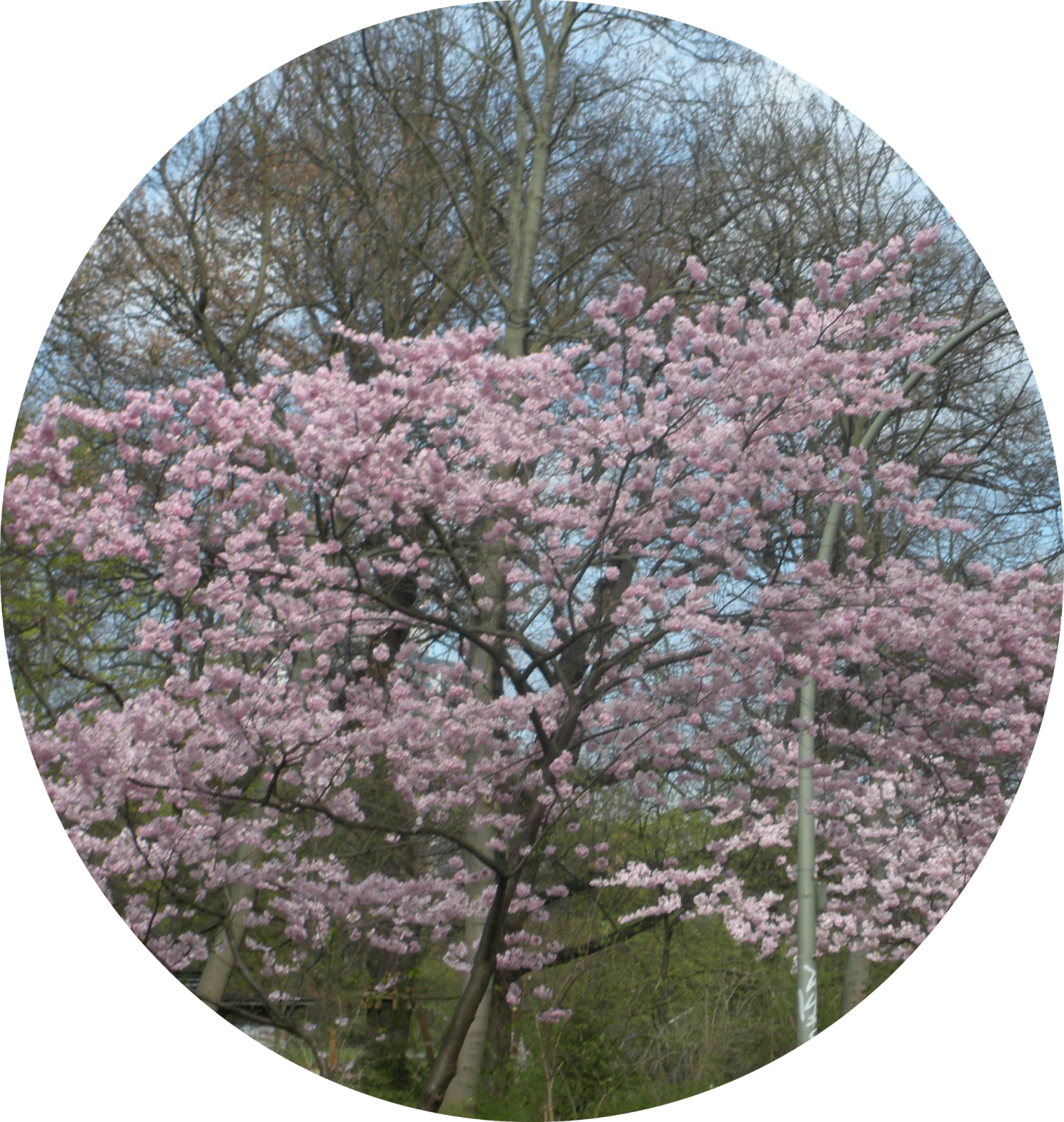

Cherry tree near Fennsee.  April 2016, my photo.


The lake ends, but the little shallow valley goes on. Now it's a park packed with playgrounds, and the playgrounds are packed with very small children bounding around in bright-colored jackets, as though someone had spilled a hundred packets of M&M's along the park slopes. (Compared to the US, there's more feeling here that small children should be roaring around outdoors a lot, and in a wide variety of weathers.)

The end of the park is almost the last bit of this little tributary tunnel-valley, and the last water in it is the duck-pond at Rathaus Schöneberg. (It used to have something of a stink problem too, like the Fennsee; but as it's so small that a reed-bed as a filter, along with oxygenation from a circulating pump, seem to have solved the problem.)

Rathaus Schöneberg and U-Bahn Station.  April 2016, my photo.

The tower in the background of the picture is the Schöneberg Rathaus, where John Kennedy made his famous "Ich bin ein Berliner" speech. (And apparently no one cracked a smile, even though "Ich bin ein Berliner" doesn't mean "I am a Berliner," it means "I am a jelly doughnut.") 

The arcade along the water is one of the grander U-Bahn station exteriors in the city.  The roof of it is at street-level--actually the roof is a street, on a bridge crossing our little glacial valley--and the trains roll through the arcade at the level of the duck-pond water. 

There's a fine outburst of classicizing sculpture on the U-Bahn-station roof/ street bridge, which is scattered with strollers and bicyclists in the mild noontime.


U-Bahn station Rathaus Schöneberg. April 2016, my photo.

I grumbled once about the lack of river-gods and nymphs and such in Berlin (compared to Lyon, specifically). But here, on the roof of the U-Bahn station, we have them in abundance--weather-battered and moss-stained and serene against the spring sky.


On top of U-Bahn station, Rathaus Schöneberg.  April 2016, my photo.

Walter Benjamin wrote about the classical figures, the "caryatids and atlantes, the putti and Pomonas" that watched over the doorways and bridges--the transition points in the cityscape--in the Berlin of his childhood around 1900. "They understood how to wait," he says of the figures. "It was all the same to them, if they were waiting for a stranger, or the return of the old gods, or the child that shoved past them with his school-bag. Under their sign, the old west of Berlin became the West of the ancient world, from which the west winds come to the seamen, who float their barge with the apples of the Hesperides slowly down the Landwehrkanal to the Bridge of Hercules."  

This was a bridge over the Landwehrkanal that used to have sculpture groups on it representing Hercules in battle with the Nemean Lion and with the centaurs. But time crumbles all these things away. The centaurs vanished in the chaos at the end of the war; the Nemean Lion moved east, to a scrap of park along the Spree. The old stone bridge over the Landwehrkanal was blown up in the war and later replaced by a minimalist, sculpture-free stretch of reinforced concrete. Hercules is still there in a fashion, however, a little beyond the bridge, in one of those over-muscled, heavy-breathing neo-baroque animal sculptures with which Wilhelm II littered the parks. (Small-city US public sculpture tends to go for animals and children; Imperial German public sculpture went for animals and warriors.)


Hercules and the Erymanthian Wild Boar, by Louis Tuaillon.
Photo by Manfred Brückels, Wiki Commons.

Louis Tuaillon, who provided the wild boar above, and August Gaul, who provided the golden stag for the imposing silly fountain on the other side of the U-Bahn station here, were fellow art students in Berlin in the late nineteenth century, in the age of fat classicizing building, of delusions of grandeur.


Hirschbrunnen by Rathaus Schöneberg.  April 2016, my photo.

The delusions stood on shaky ground, in more than one sense. One reason that there has been a lot of landscape work here--a lot of effort to separate solid ground and lake, a lot of fighting back against the tendency of Berlin to revert to its natural state of stagnant marsh--is that early in the present century the ground here in front of the U-Bahn station dropped two feet and the stag fountain nearly fell over into the subsidence. 

But the river-gods are still here on top of the station, crumbling gently, watching over the beginning--or the end--of the little glacial valley. As Benjamin says, they understand how to wait. (Maybe the whole U-Bahn station will sink into the marsh some day?)

On the U-Bahn station, Rathaus Schöneberg. April 2016, my photo.


This isn't perhaps quite the end of the valley: I think there's a bit more just beyond the Rathaus, though I'm not sure how to get to it in the mess of big streets and construction that I land in as soon as I'm out of the park. 

Well, let's see: we could try down Dominicusstrasse. Here's a sweet patch of garden beside a nursing home--perhaps one could cut through here?


On Dominicusstrasse.  April 2016, my photo.

Nope; fenced off.  Round the corner, then, into Hauptstrasse, which is big and noisy, rank with auto exhaust and blowing dust, and with so thick a crowd at the bus stop that it's hardly possible to pick your way down the sidewalk. (Arabic and Russian in the air, Turkish and cigarette smoke; women with long gowns and baby carriages, German workmen in blue overalls.) Colors dazzle on the building on the other side of the street:


On Hauptstrasse, Schöneberg.  April 2016, my photo.

And then, look straight ahead, and here's a fragment of the eighteenth-century village core of Schöneberg, dreaming among the churchyard trees in the middle of all this racket, on the little bit of solid high ground, the Berg of Schöneberg, where they planted the village in the middle ages, above the reach of the marsh.


Dorfkirche Schöneberg.  April 2016, my photo.
Tradition and strangeness dance with each other here in the loud street. The church has been on this spot more or less forever, burnt down and rebuilt and knocked down and rebuilt, over and over and over. This version is basically the one that was put up after the previous building was knocked to bits in 1760, in the Seven Years' War (French and Indian War, in US-speak), but the present occupants of the church are an Ethiopian Orthodox congregation. (The Old Catholics also get it one Sunday a month, I believe.) The German Protestant parish that originally built the village church uses the building next door: as you turn aside and climb the little height here, the pink village church with the Ethiopians in it is on your right and this slashing piece of postwar Lutheran modernism is on your left. 


Paul-Gerhardt-Kirche, Schöeneberg.  April 2016, my photo.

Incidentally, the builder responsible for the 1760 version of the village church was one "Widow Lehman, Master-Builderess, from Spandau." (The Germans still stick feminine endings onto all occupational terms, which I tend to forget--calling myself incorrectly a Professor when I should call myself a Professorin. It doesn't feel right to an English speaker, it feels like calling yourself a professorette; and someone told me that young women scholars in Germany are tending to drop the feminine endings, but I don't know.) Of course the old church burnt out again, for the umpteenth time, in WWII, but the rebuilding in the 50s was pretty much a copy of the Widow Lehman's version. 

**

Well, since I have got my creaky knees up to the level of the old church, it might be good to have a look around the churchyard behind it. It's like a florist's shop: the grave-mounds are planted thick with pansies and daffodils, hyacinths and tulips. 

The peasants or ex-peasants who owned land here and made a fortune in real estate development when the city pushed out this way in the 19th century are memorialized in the mausoleums that line the sunny wall of the churchyard. Franz Schwechten, the historicist architect with the giant mustache who appears in the previous post, is buried along here somewhere.


Schöneberg churchyard.  April 2016, my photo.

The churchyard is a steep downward slope, falling from the high ground where the churches stand to the little tunnel-valley. There are stair-steps in some places, and a smooth sloping path down the center. A well-dressed older woman comes flying down the center path on her bicycle, and the caretaker, raking last year's fallen leaves out of the ivy, tells her not to do that. (Riding your bicycle too fast is disrespectful to the dead.) She gets off and walks.

The new church--which still plants its dead in this churchyard, I think--is named for Paul Gerhardt, that fine Baroque poet and hymn-writer. If you're somewhat acquainted with Bach's choral music you will have heard Gerhardt's verse. I found it oppressive when I was a child, sitting through long Lutheran church services with long gloomy seventeenth-century hymns. Fifteen verses! Eighteen verses! All about how hard life and death are. (But as we get older we can acquire a taste for the death's-head ornateness of Baroque verse.)

Not all of Gerhard's verse is so dark, though. I was walking along the Spree in the middle of the city one summer day a couple of years ago and ran into a more cheerful bit of it. It was Angela Merkel's birthday, and a small brass band was serenading her, uncomfortably perched on one of the upper-floor terraces of the Chancellor's Office building.  They were playing a mix of older popular tunes from various sources, German and otherwise, and I was wondering idly: are these locals, or is this some kind of international birthday serenade? And then, on the lovely summer day along the water, the brass band went bounding into Geh aus, mein Herz, und suche Freud, and I thought, Oh, it has to be Germans. No one knows this but the Germans.
  
Go out my heart, and look for Freud--oh, sorry, translation glitch: look for joy--in this lovely summertime ....  The trees are full of leaves, the earth covers its dust with a green gown, the narcissus and the tulip are finer than all Solomon's silks. 

Gerhard enumerates the spring flowers and the birds with Germanic exactitude (fifteen verses!) and it all ends with death (and Paradise); but in the middle he says, I can't be still, I don't want to be still ... when everything sings I sing with everything.  

Ich singe mit wenn alles singt.  You bet. It's a beautiful day.


In Rudolph-Wilde Park, Schöneberg.  April 2016, My photo.

Tuesday, March 29, 2016

Grunewald Lakes 2

A Little Water in Villa-land

February was time for some disorderly late-winter wanderings through the lake- and fen-land in southwestern Berlin, in the long glacial scoop-out that runs down the side of the city. This is not so much "walk by the water" as "walk some considerable distance from the water because the shores are private property"--but it's an interesting neighborhood.

Today we're working along part of the little tributary valley that runs east-west to meet the north-south valley of the main Grunewald lake-chain. We start at Heidelberger Platz, about halfway along the little tributary: the streetier half of it is better for today, in the wet and cold, and we'll do the parkier half when it's really spring. 

The U-Bahn station at Heidelberger Platz is more than a little grand:


Heidelberger Platz U-Bahn station.
Photo, Stadtlichtpunkte, Wiki Commons.

We are getting down toward grand-land here, toward the old Nobelviertel with the ambassadors' residences and such. We aren't quite there yet, but already here at the station there's a flavor of the manic historicism of 1900-ish building in these parts. (Let us build big Roman railroad stations! Let us build big Byzantine banks, let us build big Venetian villas!) 

Here are the gates at the foot of the stairs, as we leave the station and head up into the late-winter drizzle:


Heidelberger Platz station gates. February 2016, my photo.

Well, I do like some ornament in the subway (and other places). I like the exuberant joy of technical skill that you see in the architecture here: Look what we can do with iron!  Look what we can do with stone, with glass, with plasterwork! 

The historicist architects who built this kind of thing in Berlin in the half-century or so before World War I don't get a lot of love in more recent times. Who even knows, these days, who Franz Schwechten was, let alone who Wilhelm Leitgebel was? These are lost names. (And there are some good reasons for not admiring them. There's too much bloat in the buildings--they're big lumpy swaggering things that no longer strike us as beautiful). But these people gave a certain feel and flavor to the city: Berlin without fat historicism would be like curry without coriander. 

Leitgebel built this U-Bahn station at Heidelberger Platz, and built the next one as well, Rüdesheimer Platz, also with ornate iron gates, just before the First World War. 


Ironwork at U-Bahn station Rüdesheimer Platz. Photo, JCornelius, Wiki Commons.

The war pretty much put an end to the lush replication of historical styles in architecture in these parts. It also pretty much put an end to ornament (especially naturalistic ornament) on buildings. Starkness and abstraction set in. (Does this really make sense? Slaughtering fifteen or twenty million people means that we can't represent vegetation in the subway stations any more?)

It's partly guilt by association, of course. Fat historicism was the dominant style of the dominating class in Germany before the war, and these folks seemed utterly bankrupt--politically and intellectually and artistically as well as economically--by 1919.  'Tis well that an old age is out,/ And time to begin a new, as people always say after slaughters. (The lines are Dryden's celebration of the end of the murderous seventeenth century.) Time for white concrete cubes and the like, in the streetscape. 

The guilt by association isn't entirely unfair. Fat historicism kept some bad company in Germany. Gothic revival, for example, gets carried along on different political currents here than in the Anglo-American world. English neogothic architecture carries with it a breath of Ruskin's and Morris's utopian socialism; model workers' housing in England can be neogothic. But socialist neogothic is not so likely here, where medieval architectural styles were kidnapped by aggressive, conservative nationalism. 

Here at Heidelberger Platz we're on the edge of a neighborhood called the Rheingauviertel, named for the Rheingau wine region in Hesse; the street and square names are names of villages with well-known vineyards. (If you're a Riesling drinker, the names should sound familiar: Rüdesheim, Johannisberg). This is not altogether about innocent joy in good wine, however. I think that the (numerous) quarters in Berlin that were developed in the later nineteenth century and named for other parts of Germany were in part declarations of national connectedness, declarations that Berlin was the capital of all these places. (Not an uncontroversial statement, in the days when Germany as a national state was new.) 

Thus there's some nationalist aggressiveness stirred into the good wine; and especially as we get closer to the turn of the century, the historicist style gets to be kind of a bad drunk. (It's loud and rude, it talks tastelessly about money and power.)

You can sort of get the tone of the time from looking at Franz Schwechten, who was a big-time historicist architect in Berlin in the decades before WW I. A bit overbearing in style, perhaps. 


Franz Schwechten, about 1895. Photo, Wiki Commons.

Schwechten, whose name is largely forgotten these days, built major Berlin landmarks. He built the Kaiser-Wilhelm-Gedächtnis-Kirche, the church on Kurfürstendamm that was left as an iconic semi-ruin after WW II, as a warning against wars. He built the dopey tower in Grunewald in honor of Wilhelm I (see Havel 4 post from last summer). He built the ex-brewery in Prenzlauer Berg, the Kulturbrauerei, that in these days is stuffed with clubs and theaters and such and is a big gathering-place for the young. Schwechten also built the wildly Gothic part of our local power plant in Moabit (see Berlin-Spandauer Schiffahrtskanal 2 post). (Don't you feel that your neighborhood power plant needs a Gothic turret or two?)  

Ah well, up the steps we go from the U-Bahn station, to the more brutal beauties of the postwar city. (I love the Berlin power plants, including ones like this--but surely the freeways are esthetically unredeemable?)

Kraftwerk Berlin-Wilmersdorf and highway. Photo, Dieter Brügmann, Wiki Commons.

Then we are past the freeway, into one of those non-grand little scraggles of city that are left over from highway-building, like scraps of fabric left when you've cut out an odd shape like a sleeve or a collar from a length of fabric. 

Here is vacant land, fenced-off land of uncertain uses. Among the simpler graffiti someone has painted a woman with a bandage over her mouth and the legend, "She does not have the courage of her opinions."


Near Heidelberger Platz.  February 2016, my photo.

Well, me either, much of the time. 

In the course of development, some stretches of the tunnel valleys out here were drained and filled in, while others were deepened to gather the waters and turn them from seasonal damp spots to year-round lakes. Here is an oddity, an apparently unnamed, somewhat seasonal pool, an unreconstructed stretch of low ground along Forckenbeckstrasse that collects excess water when there are heavy rains. It stands behind the big Wilmersdorf Secondary School, in a way that is in principle handsome ....


Wilmersdorfer Sekundarschule and pond, Forckenbeckstrasse.  February 2016, my photo.

... but mein Gott, this place is filthy. How trash-strewn the water's edge is, what dubious and rotting objects float in the water. Where is Max von Forckenbeck when we need him?  

He gets a street named after him because he was the Oberbürgermeister of Berlin for fourteen years, beginning in 1878, and would have held the office longer if he had not died of pneumonia in 1892. Berlin was in its wild weedy industrial growth period then, with more people coming in from the poor countryside than the city could hold; insanitary shantytowns were crammed into the dank edges of the city. (Think Rio, think Delhi, though on a smaller scale.) Forckenbeck built sewers and schools, and transit and clean water supply and park space, and more sewers and more schools and more transit, and did it without making a mess of the city finances. A good man, Forckenbeck. 

As we go round the west end of this body of water, this rotting corpse of water, the path through the trees climbs toward something dark and angular:


Path to back of Kreuzkirche. February 2016, my photo.

It looks a little grim on such a shadowy winter day (terrible day for taking pictures, there's no light). But here's our alternative to historicist architecture, before classic modernism--the real white-cube stuff--comes along. This is Expressionist architecture, north-German brick Expressionism, which I had no idea existed until I started wandering around Berlin. (I thought Expressionism was all angry periodicals put together by young men and given titles like Storm and Action; I thought it was poems that invoke the end of the world ("the hat flies off the bourgeois's pointy head ... the trains fall off the bridges"), and Edvard Munch painting The Scream, and Alban Berg writing sex-death-and-dissonance operas.  But an Expressionist church building?? This was news.)

I think the first time Archangel and I seriously paid attention to this kind of building was several years ago when we were in Hannover and fell somewhat in love with the Anzeiger Hochhaus, a 1920s newspaper building that was one of the first high-rises in Germany and has a terrific street-presence.  

Here's a bit of the Anzeiger Hochhaus, with the dramatic outlines and the dark, prickly, twisting brickwork that is characteristic of these buildings.


Anzeiger Hochhaus, Hannover. Photo, Carl Dransfeld,
between 1928 and 1938.Wiki Commons.

And here's the Kreuzkirche in Berlin, as we sneak up on it from behind, from the rotten pond. Also some dramatic shapes and zippy brickwork:


Kreuzkirche, Berlin-Wilmersdorf. Photo, Manfred Brückels, Wiki Commons.


The Expressionists liked distortions and startlements, and we get one as we come around to the front of the church here. It has a blue majolica, somewhat pagoda-like entryway, where I shelter for a while from the increasing rain. 


Kreuzkirche entryway. Photo, Mutter Erde, Wiki Commons.

There's a dubious smell about a lot of the Expressionist work, as there is about the pond we have just passed. Fritz Höger, who was officially the architect of the Anzeiger Hochhaus in Hannover, got into various problems for plagiarism, including for the Hannover building, which is over-dependent on the design of an unsuccessful rival for the commission. Höger also is the nominal architect of a very striking Expressionist church in this neighborhood (Hohenzollernplatz) which is said to have been mostly designed by his junior in the office, Ossip Klarwein. (Klarwein was a Polish Jew whom Höger--an early and sincere Nazi--fired for being Jewish already in 1932, before there was any pressure to do so, since the Nazis were not yet in power. Klarwein had the good sense to get out to Palestine before worse things happened.) 

Some of the other Expressionists, painters and poets (Emil Nolde, Gottfried Benn), were enthusiastic Nazis as well. Nazism appealed to their anti-modernism, their hatred of cities and machines; it appealed to their taste for violent feelings, their glorification of the manly Nordic world. After an initial flirtation with Expressionism, however, the Nazis didn't love them back; the Party sold off or burned their paintings and burned their books. The Nazis mostly left the architecture alone, however. (After all, it's harder to change or destroy a building than to burn a painting.)

... But dear me, we've wandered a little out of the straight path to the lakes here. (Getting past the freeway, being distracted by this and that, being reluctant to pull out the map to get it wet in this drizzle.)  Here we are at Grieser Platz, which is a little farther north than we want to be.


Europa macht Handstand, sculpture by Ernst Leonhardt, 1995.
Grieser Platz.  February 2016, my photo.


A few streets further on, and we're into Grunewald--Grunewald the sub-district, not (yet) Grunewald the forest. Nobelviertel stuff from here on. No more big graffiti, no more jokey 1990's public sculpture. 

Big, big old villas, ravingly historicist:


Villa, Grunewald. February 2016, my photo.

... mixed with clinically severe modernism. (The modernism is like a breath of fresh air in a room that's been shut up for too long--but if the whole city looked like this, it would be like living in the open in a perpetual cold wind.)


On Caspar-Theyß-Strasse.  February 2016, my photo.

The street stirs together old and new styles, villas and apartments and commercial space. (Near the buildings in the pictures above is the most architecturally discreet auto-repair place I have ever seen.) The mix gives the neighborhood its peculiar flavor, a kind of sweet-and-tart tang, not like a mono-style residential suburb.

Here we come to Koenigsallee, which is sort of a main drag through the neighborhood. There should be a bus stop along here, which would be good to note for the future .... Aagh, it's a ravingly historicist bus stop:


Departure for the hunt under Kurfürst Joachim II from Jagdschloss Grunewald.
Mosaic on Koenigsallee. Photo by Axel Mauruszat, Wiki Commons.

This mosaic represents the sixteenth-century Kurfürst (Elector) Joachim II heading out for the hunt from the Jagdschloss (hunting lodge, sort of) Grunewald. (The Jagdschloss is on one of the lakes in the Grunewald lake chain, and we will get to it some day when it stops raining. Preferably well into the spring, when the place is open so we can have a look at the sixteenth-century paintings inside; I think the place is closed during the winter.)

One of the paintings in the Jagdschloss is a closer look at Joachim II himself, a contemporary portrait without any sentimentalizing 1900ish cleanup. He looks more than a little dangerous.


Joachim II of Brandenburg, by Lucas Cranach the Younger.
Photo, Wiki Commons.

He was, too. Debased the coinage, oppressed the merchants, confiscated property in the interests of his building and territorial-expansion projects, and loaded the country with debt. (His successor solved the debt problem in part by plundering the Jews in Brandenburg, expelling them and keeping their property.)

It's all clean and pretty in the mosaic, and we can grumble about that if we want to.  But the mosaic is appealing as another example of the exuberant technical skills of 1900-ish Berlin. The mosaic was executed (not designed) by the firm of Puhl and Wagner in 1910, which had been busy putting an end to the millennium-long Italian lock on technically-high-quality mosaic production.

Mosaics were used to decorate the Berlin bridges in those days.  A few of the bridge mosaics are still in situ, for example on the Oberbaumbrücke that crosses the Spree to link Kreuzberg and Friedrichshain [see Spree 5 post, June 2014]--this is also Puhl and Wagner work.

Puhl & Wagner mosaic, Oberbaumbrücke.
Photo, Andreas Steinhoff, Wiki Commons.

The Departure for the Hunt mosaic at the bus stop used to be on a bridge in the neighborhood here (specifically, the Hohenzollerndammbrücke--which is a bit of a mouthful). The hunting scene was on one side of the bridge, and the Surrender of the City of Teltow was on the other side. (Perhaps a scene from the thirteenth-century Teltow War between Otto-with-the-Arrow and Heinrich the Illustrious? [see Teltowkanal 5 post, January 2015].) When the bridge on Hohenzollerndamm was replaced in the 1950s, the Teltow mosaic was destroyed, but the hunting scene was saved and slapped onto the side of the old folks' home here by the bus stop.

**

We're into big-villa territory here. Farther down Koenigsallee, early in the last century, was the home of Walter Rathenau, a big man in the German economy before and during World War I, and then a political figure--mostly a diplomat, trying to work down the international tensions that were still rocking the world off-balance for years after the war. 

The Rathenaus ran AEG, the German equivalent of General Electric. Franz Schwechten, the historicist with the big mustache, did some building for AEG: this is the gateway to the AEG works in north-central Berlin:


Gate to AEG works, Berlin.  Photo by Ansgar Koreng, Wiki Commons.

But Walter Rathenau's personal tastes ran in a different direction: his villa--which he designed himself, for the most part--is soberly classical, in the tradition of early nineteenth-century Prussia. (No turrets, no gold, no mosaics: Rathenau was an admirer of the coolness, the spareness, the moderation of Schinkel's aristocratic Prussian country houses.)  

Not everyone saw Rathenau as a legitimate inheritor of Prussian tradition, however. Just here, past the bus stop, there's a marker at the awkward intersection on Koenigsallee where Rathenau's chauffeur slowed down to make the turn one morning, and the car behind sped up, one of the occupants firing a machine gun into Rathenau's car and another tossing a grenade.  

This was 1922, so this was the work of old-line right-wing extremists, not Nazis yet. The assassins' organization didn't like Jewish industrialists and was also hoping to prey on the country's fears, to set off a civil war, to pave the way for a military dictatorship. It didn't happen, not yet; the country kept its nerve, more or less, and got another ten years or so of quasi-peace. There's a street-side marker here at the site of the assassination; it looks stern in the wintry afternoon, and desolate, with moss eating away at the stone.


Walther-Rathenau-Denkmal, Koenigsallee.  February 2016, my photo.

A little further down Koenigsallee, and we're at a bridge over the little canal that links the Herthasee and the Koenigssee. These aren't natural lakes, they were made for decoration and drainage when this area--once called the Round Fen--was drained for real estate development in the 1880s.

Koenigssee.  February 2016, my photo.

Just past the bridge is a massive piece of eclectic historicism, the Villa Walter (named for its otherwise-forgotten architect, Wilhelm Walter). This comes from a time and place much given to overfed architecture, and the Villa Walter is a great big lump of a building.


Villa Walter. Photo, Lienhard Schulz, Wiki Commons.

It's bursting with garlands and mythological figures and symbolic representations in stone: crowds of naked angels hold up the building's protrusions. 


Villa Walter. February 2016, my photo.

Latin mottos are everywhere, mostly in stone .... but there are some in gold at the bottom of this slather of mosaic in the gable. Architecture the mother of the arts is on the right.  On the left is a line from Horace: Nil sine magno vita labore dedit mortalibus.  Life gives nothing to mortals without great labor.


Villa Walter. February 2016, my photo.

These mottos sound a little self-advertising, and they were probably so intended. Allegedly--I don't know how true these tales are--the house was commissioned by a Russian aristocrat around 1912, but it wasn't yet finished when WW I broke out and the commission went south.  Walter decided to finish up the house, to live there himself and use it as a kind of calling card: see what I can do! 

But then the world that cared for this kind of thing fell into slaughter and bankruptcy. When Walter finished the house in 1917, he had hopelessly overextended himself financially and saw no usable future. Even with great labor, life may not give you so much. He is said to have hanged himself in the tower. 

These days the house belongs to the Rumanian Cultural Institute. You can come out here to learn Rumanian, if this task is high on your agenda, or to see Rumanian art, hear readings from Rumanian literature, and so on. 

Farther down Koenigsallee there's a useful footpath called the Hasensprung that takes us back down to the water. 


Hasensprung.  February 2016, my photo.

Hasensprung (like other place-names in this corner of the city) is a vineyard in the Rheingau. But literally the word means rabbit-leap, and there are a couple of rather defaced stone rabbits on the bridge that takes us across the water.  Koenigssee on one side, demented-looking rabbits in the middle, Dianasee on the other side, in the silver-dark of the winter afternoon. 


Koenigssee from Hasensprung bridge. February 2016, my photo.


Hasensprung bridge.  February 2016, my photo.


Dianasee from Hasensprung bridge. February 2016, my photo.

Then up we go, out of this little tributary tunnel-valley, to another street named after a Hessian vineyard, which will eventually take us round to the Grunewald S-Bahn station. 

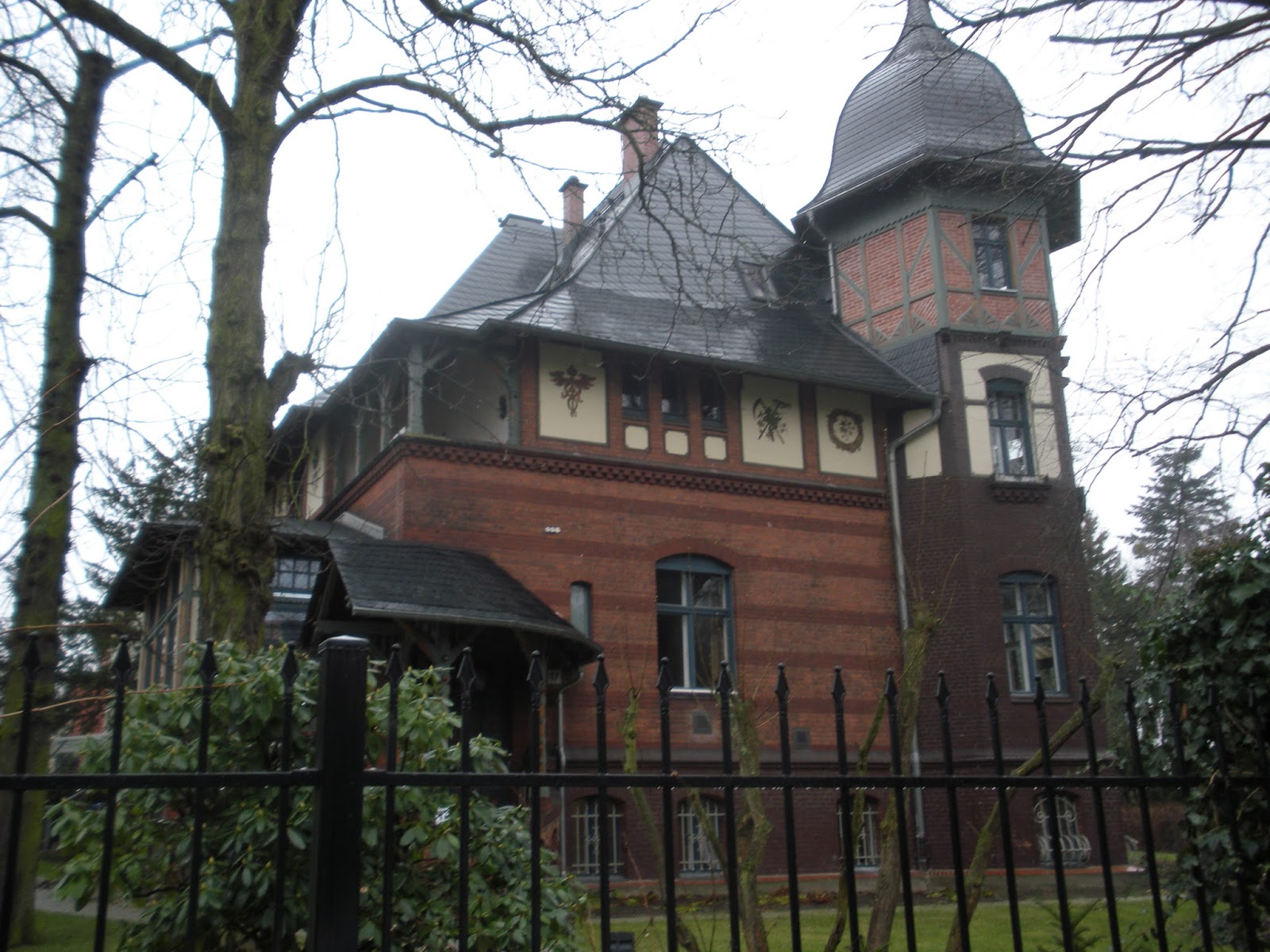
It's a nice walk, the villas have their charm. Mostly it's very well-kept along here, but at one point there's a startling derelict, fenced off and apparently abandoned. This is the Villa Noelle, built around 1900 in vaguely German-Renaissance style for Ernst Noelle, a trader in steel back in the boom times of German steel-making. After Noelle died in 1916, the property changed hands a number of times, more than once by foreclosure sales; in the latter part of the 1930s someone turned it into biggish upscale apartments.  


Villa Noelle. February 2016, my photo.

The apartments were still occupied ten or twelve years ago, and perhaps more recently. There are still names on the doorbell-plate at the gate, but the gate is padlocked. The place has a scraggy haunted look, and the clock over the door has been stuck at 10:00 for years. Perhaps the property has fallen into some legal dispute or financial mess that the participants choose not to air in public; although there's a lot of information available on the past of the house from local websites and newspapers, there's a dead silence about the present.

At the side of the locked gateway there is a decorative iron plate let into the now moss-eaten stone, in the German tradition of putting proverbs on the walls. (I like this: why don't we paint or carve big proverbs on our houses in the US?) This one says, Wägen, wagen.  Weigh--that is, consider--and then dare. 


Gate relief on Winkler Strasse. February 2016, my photo.

Think ... and then have the courage of your opinions, as the graffito near Heidelberger Platz says.

Another of the relief plates on the locked gate says, if I remember correctly, Entscheidung ist alles. Decision is everything. 

Well, I don't know; the dereliction here gives an ironic surround to this kind of chest-thumping. But maybe in another ten years some oligarch will come along and restore the place and polish up the proverbs--like Herr Noelle, fancying his success as the result of his own thinking and daring and decision, and forgetting that it helps when history tosses you some softballs.