Friday, September 11, 2015

Havel 3

Tegel-place and Humboldt-land

At about the latitude of Tegel Airport--where you still fly into Berlin if you aren't arriving on something like EasyJet or Aeroflot--the Havel bulges out to the northeast in a long, be-islanded lake, the Tegeler See. 

This is a favorite place. The east shore of the Tegeler See is where we start for that happy summer ritual, walking up the Tegeler Fließ (see Tegeler Fließ posts, Sept-Oct 2014). The edge of the Tegeler See is where I got my first Berlin hiking map (Hiking in the Green North of Berlin!) at a kiosk in the street that runs down from the U-Bahn stop to the harbor, where the big Havel cruise-ships start. (These include the egregious Moby Dick, which I think goes downriver as far as Potsdam (we should end up there before the snow flies) and upriver as far as Brandenburg city (not this year).)
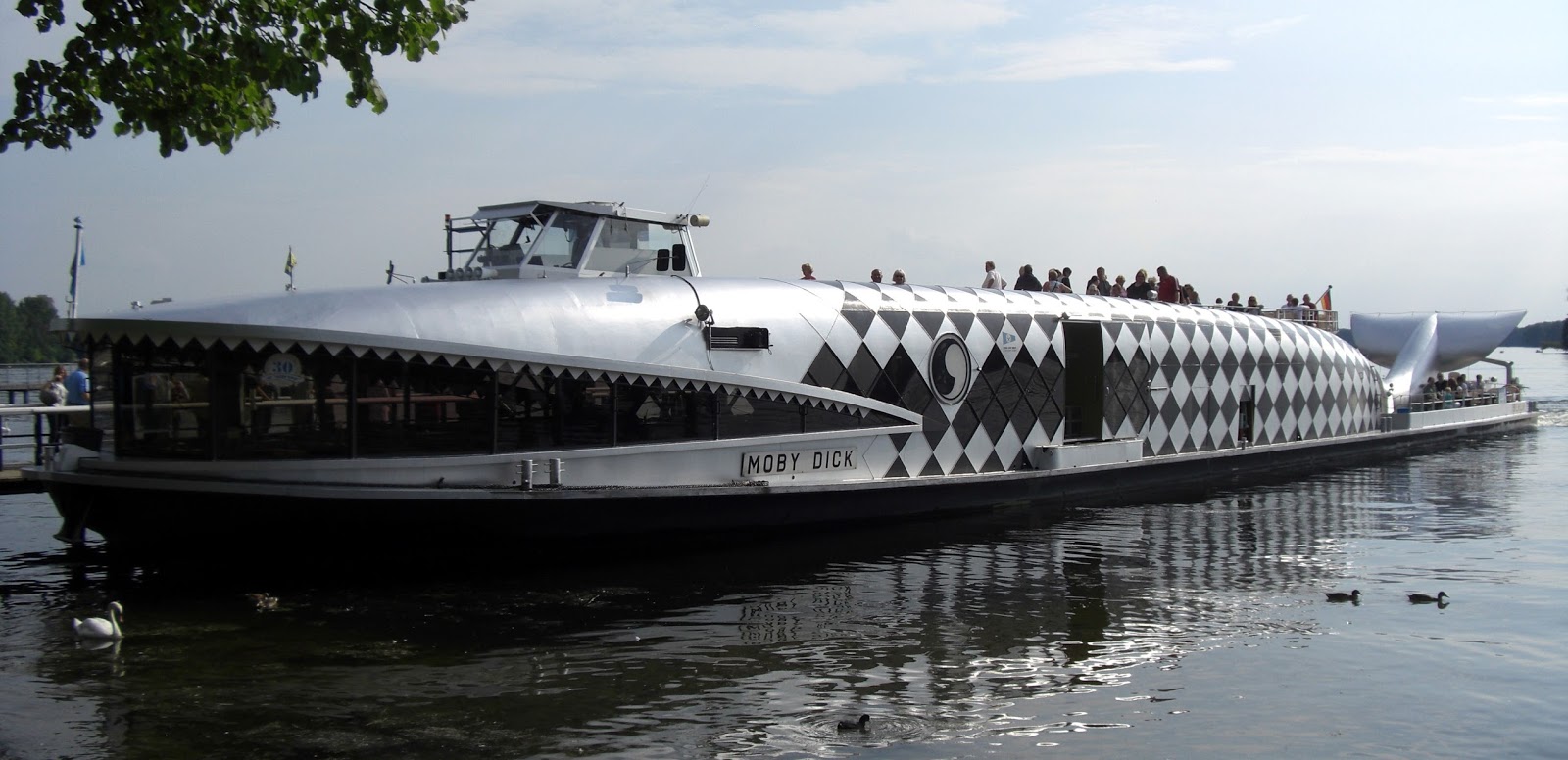
Cruise ship Moby Dick, docked at Greenwich Promenade, Alt-Tegel.
Photo, Havelbaude, Wiki Commons.

I've never been over on the west side of the lake, which is mostly occupied by the Tegeler Forst. I'm thinking maybe this is the time to see the west side at last, and to give some thought to Wilhelm von Humboldt, who grew up by the lake along with his brother Alexander. (Alexander appeared in the first Tegeler Fließ post from last summer, but not Wilhelm.) I admire Wilhelm; I've spent most of my adult life in the house that Wilhelm built, so to speak: the modern research university. 

He didn't build it all by himself, of course; he didn't even build the University of Berlin--that original and model of the modern research university. He wrote up some plans for it and got started with things like hiring and funding (in the middle of the Napoleonic Wars, not an easy time). These activities got him into wrangles with higher-level people in government, who kicked him upstairs into a diplomatic position before the school was very far along. But he had ideas about what the institution should be, and these ideas have stuck.

Here's poor Wilhelm, trapped in a late-Victorian marble chair by the front gate of the university on Unter den Linden. Brother Alexander is trapped in another one on the other side of the gate, looking somewhat less oppressed by the situation than Wilhelm is--unsurprisingly, since (as far as I know) all Alexander had to do with the place was to drop in and give spectacular guest lectures. He didn't have to wrangle with faculty about hiring and with government about budgets.


Wilhelm von Humboldt monument on Unter den Linden,
Photo by Christian Wolf, Wiki Commons. 

Here they sit guarding the entrance to the university, like lions at the entrance of a temple, like allegorical figures of Naturwissenschaften (Alexander) and Geisteswissenschaften (Wilhelm)--that is, natural sciences and ... oh dear. The intrepid young German possessed of a dictionary will translate Geisteswissenschaften as "sciences of the spirit," but of course this is not English: no university catalog in the US or UK includes a section on "sciences of the spirit." The Geisteswissenschaften certainly include history and literature and linguistics and religious studies, maybe philosophy and law--and maybe, in the most capacious view, almost everything that isn't natural science and math. (I observe that English Wikipedia sensibly translates Geisteswissenschaften as Geisteswissenschaften.) 

In English we think we can divide up the scholarly world fairly neatly between natural sciences, social sciences, and humanities; but here in Germany the concept of social science is rather wobbly. (As perhaps it should be. Do we really know what we mean by social sciences, or how they are supposed to work?) In the US, we would classify psychology and sociology and economics as social sciences, but in Germany this is not so obvious. In the current college (Fakultät) structure at Archangel's university, psychology has been put together with agriculture and biology to make a life sciences college, which lives near the medical school. Sociology has been integrated into a single department with political science and belongs to the same college as art history, music history, education, archaeology, and the study of sports. (This combination is non-standard, but I don't think it has seemed quite as bizarre here as it would in the US.) Economics is a college unto itself, including what would be called business in the US but often isn't in Germany. (In people's minds here, "business school" wobbles back and forth between meaning something glamorous like Harvard Business School and meaning something sub-academic like secretarial school.) 

Well: labels, names ... Wilhelm thinks a lot about this, he's a linguist. “The diversity of languages is not a diversity of signs and sounds but a diversity of views of the world,” he says (famously), in his Essay on the Comparative Study of Languages--which he writes in old age, sitting up here in the family house at the head of the lake. He's one of the first people to grapple seriously with the idea that different languages are not just code-books that attach different labels to the same pre-defined pieces of the world. Instead, the world as we experience it is truly different in different languages; we ourselves are different in different languages, because language gives us a non-trivial part of our self-understanding. Language is what makes us more than just incoherent lumps of appetite, he says. And so an understanding of how language works must be involved with any systematic investigation of distinctly human activities: the Geisteswissenschaften as opposed to the natural sciences. 

Wilhelm understands the differences among languages more than many of his peers. Other scholars are also interested in comparative languistics at this time: some of them, especially in France, are trying to identify a Universal Grammar. It has an unfortunate tendency, however, to come out looking like French. Unlike his peers, Wilhelm is not Eurocentric. He has some acquaintance with Chinese and Japanese and Arabic; he has written a Coptic grammar and has translated the Bhagavad-Gita from Sanskrit to German. His Essay on the Comparative Study of Languages is written as an introduction to an analysis of one of the Javanese languages; in his old age, looking out over the islands of the Tegeler See, he is studying the languages of the Pacific Islands. When he was younger, it was Native American languages. He does not expect them to be much like French. (Or German either.)

**

Here's a little puzle of place-names. We're starting out in a place called Tegelort, which means "Tegel-place." It's right on the shore of the Tegeler See but is not in Tegel, the sub-district of Berlin that wraps around all of the Tegeler See except this little bit. (Why isn't Tegelort in Tegel? Don't ask me, I just live here.) We start off nicely by the water and then run whack into a fence with a locked gate, but it doesn't take too long to go around and get back to the water again.


The Havel at Tegelort, July 2015. My photo.

Tegelort itself is a little scrap of late-nineteenth-century suburb at the edge of the Tegeler Forst. Houses and restaurants were built out here in the boom times after the Franco-Prussian War, and in the next few decades all the usual institutons followed: the school, the fire department, the streetcar connection into the city. 


End of the streetcar line, Tegelort. Postcard, 1913, Wiki Commons.

In the 1920s and 30s people came out here from central Berlin a lot on the weekends, and entertainments sprang up: besides the boating and swimming and restaurants, there were bowling alleys and carnival rides, theaters and movie houses. There is an idiomatic phrase in German, mit Kind und Kegel, which means with the whole clan or the whole household (kids, pets, baggage--the whole kit and kaboodle, Americans might have said at the time); the popular advertising slogan addressed to the weekenders was: mit Kind und Kegel, out to Tegel! 

Much of the old weekending business is gone now; the main public-transit line and thus more of the action is on the other side of the lake nowadays. There's still a fine swimming-beach on this side, and a scattering of small guesthouses and restaurants, and of course there's a lot of boating; but the neighborhood seems quiet and housey. No more carousels and bowling alleys. Nice roses along the path.


Roses, Tegelort, July 2015. My photo.

The south end of the lake is full of islands, large and small, and variously occupied. There's a boarding school on the biggest one; there are camping places and Kleingärten and such on the others. If I have been paying proper attention to my map, which is questionable, this island is Lindwerder, which is a curious little place. It started out as a patch of sand about 300 meters square;  it's more than twenty times that size now. 


Island in the Tegeler See.  July 2015, my photo.

On the other side of the water was (is) the Borsig works--Borsig was the biggest locomotive producer in Europe in the nineteenth century, when railroads were the new technology that was blowing the old social organization to bits, rather like computing technology in more recent times. The Borsig works dumped the slag from its foundry onto Lindwerder, gradually enlarging it.  Fairly clean slag, fortunately: the water-testers say that that there are no toxics coming from it into the lake water or the well on the island.

Small world, up here. In 1858, when the Borsig works produced its thousandth locomotive, there was a big celebration. Alexander von Humboldt was invited (Wilhelm was long dead by then), and he showed up; he was almost ninety but still interested in the latest technology. 

**

The University of Berlin, as Wilhelm von Humboldt planned it around 1809 and as it grew up in the course of the century, was different from places like Oxford and Cambridge. One important difference was the larger role that it gave to the natural sciences and to research in general. The English were still wrangling in the 1850s about whether universities should expand their scope of studies very far beyond Greek and Latin literature. (Should Modern History--that is, the history of the world after the fall of Rome--be a university subject? Should chemistry be a university subject? Maybe not chemistry, it seems too commercial. Solving practical problems with commercial consequences is not consistent with "the dignity of the university," as an Oxford Fellow of the time put it.) 

It was also not clear to the English that it made sense to try to pack into one institution the task of advancing the frontiers of knowledge and the apparently very different task of civilizing the young--keeping them from drinking themselves into oblivion and running up debts their parents couldn't pay. Many people in mid-nineteenth-century England thought that research belonged in London, as part of grown-up city life, and teaching belonged at small-town Oxford and Cambridge, where there was some hope of limiting the students' dissipations and turning them into gentlemen by way of sufficient immersion in the classics. 

The Humboldtian ideal, in contrast--and you can hardly have a discussion of university policy in Germany without someone invoking this phrase--was die Einheit von Forschung und Lehre, the unity of research and teaching. Odd as it may appear, Wilhelm thought, the two tasks did go together. And it seemed to work, the Humboldtian university. After mid-century the English universities were re-modeled to be more like it; and new institutions on the Berlin model, like Johns Hopkins and the University of Chicago, sprang up in the US.

The university turned out to be a fine place for the sciences, for research, in spite of English skepticism. The English worries, about civilizing the young and about dangerous commercialization, were and are legitimate concerns; but still, it was a fine time for the sciences here in Berlin before the Nazis. In the generation between the first Nobel Prizes (1901) and the Nazi takeover in 1933, nineteen of the prizewinners in the sciences (chemistry, medicine, physics) were people with Berlin connections. (Harvard picked up one prize during this period.) 

It was new, new science, kicking to pieces the old understanding of the physical world. (The Harvard prize was for a more accurate measurement of the atomic weights of some elements.) Max Planck and Erwin Schrödinger were working on the beginings of quantum theory in Berlin. Albert Einstein was working on relativity theory in Berlin--or working on it out here along the Havel, which he said was a better place for thinking than the middle of town. He and his family had a Kleingarten a little downriver from here. (The Einsteins' garden was so messy that the neighbors complained and they almost lost their lease. When he was out here he wanted to be thinking or sailing--he was a passionate Havel-sailor--not pruning the shrubbery.) 


On the Tegeler See, July 2015. My photo.

**

We're getting north along the lakeshore, closer to the Humboldts' property. It's a pleasant stretch of woods and water here--fine young oaks on the woods side:


Oak trees along the Tegeler See, July 2015. My photo.

and on the water-side, sometimes little coves full of green reflection:


Along the Tegeler See, July 2015. My photo.

There are open stretches of shoreline here and there--doesn't this look Midwestern?  Somewhere in Wisconsin, somewhere in Michigan.


Tegeler See, July 2015. My photo

**

After Wilhelm and Alexander von Humboldt were dead, their heirs sold a couple of islands in the northern part of the Tegeler See--Big Heron Island and Little Heron Island--to the Borsig heir. He filled in between the islands and the shore to make a peninsula and built a big villa there, close to the new home of the Borsig works. It had just moved out from center city and was about to start expanding little Lindwerder with its slag. 
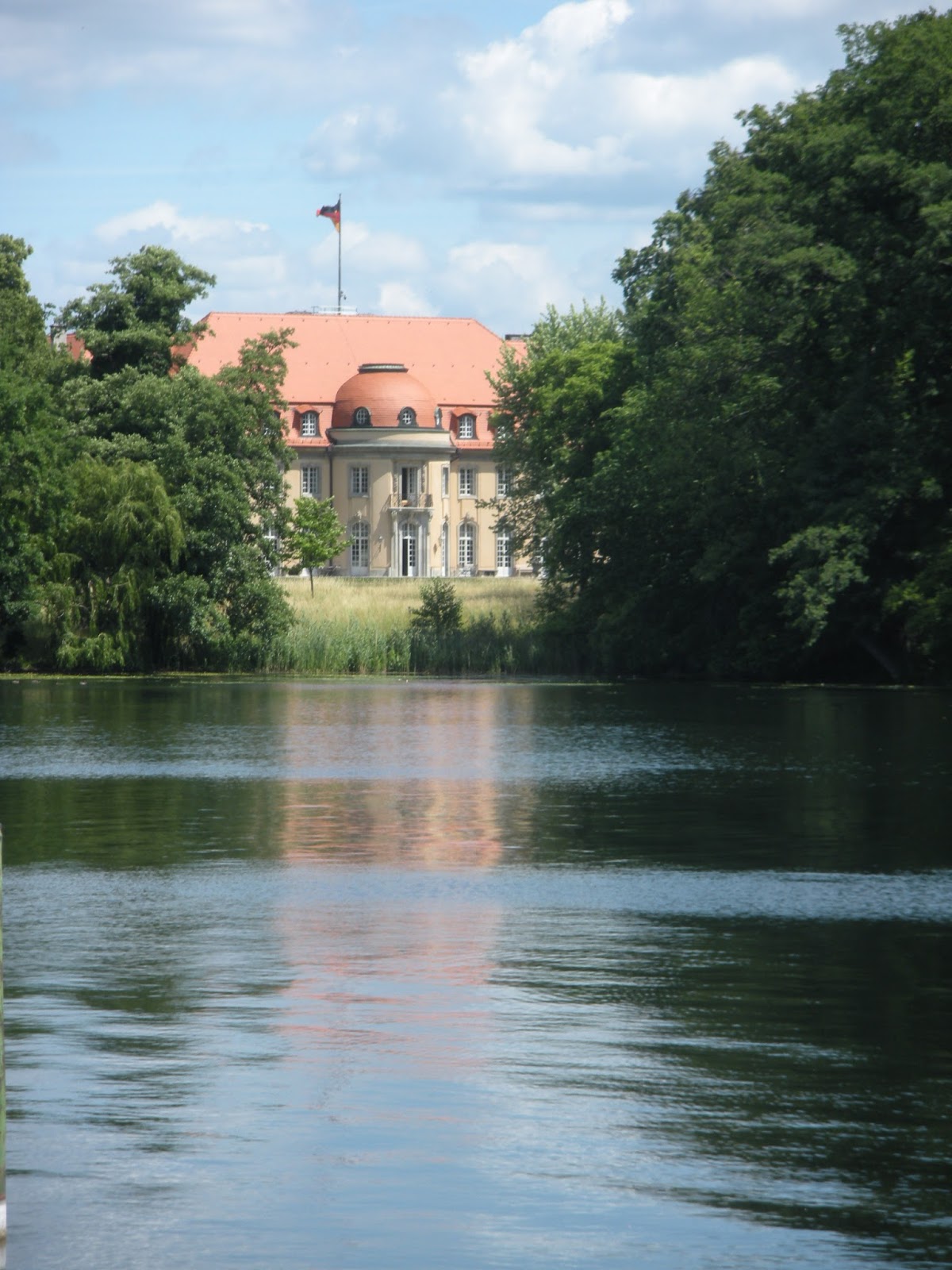

Villa Borsig on Tegeler See, July 2015. My photo.

In the 1920s an engineering intern at the Borsig works, who was probably supposed to be working on locomotives but was obsessed with the idea of liquid-fuel rockets, slipped off to Lindwerder when he could, to fire off his experiments. On the island, after all, there was not so much danger of setting the neighborhood on fire.

Later he would get his Ph.D. at the University of Berlin, then at the peak of its Humboldtian success. Later he would be a Nazi party member and SS man and would make the V2s that terrorized London. Later still he would be adopted by the American military and would develop the rockets that took Americans to the moon. (As Tom Lehrer sang in the 1960s,  "Once the rockets are up, who cares where they come down?/ 'That's not my department,' says Wernher von Braun.")

**
Things change, things change. The Borsig Villa belongs to the German diplomatic service now. The Borsig manufacturing operations in Tegel belong to some firm headquartered in Kuala Lumpur. They make complex production equipment for the chemical industry and ship it out from the little harbor on the Tegeler See to Asia and elsewhere. (They have to transfer to bigger vessels in Hamburg harbor, of course, but it still beats trying to move twenty-ton pieces of equipment in trucks.) 

**

We've come around the top of the lake, through the edge of the woods that run up to Schloss Tegel. Wilhelm, who perhaps would rather have been in Rome, spent the last decades of his life here, writing. (My feeling is that work is as much a human need as food and sleep, he said.) There had been a period when he had not had so much time for languages, and he was happy enough when that time was over. When the university project ran into difficulties in 1810 he had been sent to Vienna as a diplomat. He did background work helping to bring Austria into the coalition against Napoleon, which finally (unlike the previous five coalitions) marched into Paris in 1814. Then Wilhelm was one of the Prussian representatives at the Congress of Vienna, which re-drew the map of Europe, post-revolution, post-Napoleon. 

Then he was ambassador to London, then a minister in the Prussian government, trying without success to create a liberal constitution for the country. Central Europe was descending into authoritarian reaction; Wilhelm finally lost his job for standing out against the expansion of censorship and the removal of liberal university professors. Time to go back to the study of languages. You act when you can act, and when you can't act you retreat up the Havel and think .... 

After Wilhelm died, in the 1830s, Alexander (who would certainly rather have been in Paris) took over the family house at Tegel and spent the last decades of his life here, writing. The figure in the print below, half turned away from the view of the house and the lake, is perhaps meant to be Alexander.  


Schloss Tegel, 1855. Engraving by J.G.F. Poppel, in 
Das Königreich Preussen in malerischen Original-Ansichten, British Library.
Wiki Commons.

The lawyer who owns the house now is Wilhelm's great-great-I-do-not-know-how-many-greats-grandson. Wilhelm and Alexander are buried under the centuries-old oaks west of the house, under classicizing monuments, rising one near the other, like the marble chairs by the university gates.

**

Round we go, around the north end of the lake and a blobby extension of it called the Große Malche, which makes a good boat harbor. 


Boat Harbor, Grosse Malche, Tegeler See. July 2015, my photo.

There's a bit of park here, with a scattering of old ladies (like me) taking the summer-morning air, and a sculpture called The archaic angel of Heiligensee ...


Hannah-Höch-Denkmal, Tegeler See. July 2015, my photo.

... which is a memorial to a German Dada artist of the 1920s, Hannah Höch, who lived up in Heiligensee, north of here along the Havel. (Lovely dune-woods in between: I've walked from from Tegel to Heiligensee in other summers, guessing my route through the unmarked network of forest paths. Woud I do this with more confidence now that I have my mobile-phone compass? Probably not; Archangel and I compared our compass apps the other day and found that even under the most favorable circumstances they had substantially different views about where north was.)

Then we're in Tegel town, Alt-Tegel, where the main transit lines to center city run now. Through a patch of Kleingärten, bursting with summer flowers (what a year for the roses--mounds of roses, streams of roses); and then down to Tegel Harbor.


Tegel Harbor,  July 2015. My photo.

This used to be industrial territory; it was cleaned up and developed residentially in the late 1980s. The design (including the metal whale in the water) was provided by Charles Moore, whose work may have a vaguely familiar look to people who hang around American universities. He is also responsible for the carillon tower on North Campus at the U of Michigan, the Haas Business School at Berkeley, and pieces of UC Santa Cruz, Santa Barbara, and Irvine (to say nothing of Williams College). If you wander around the Tegel Harbor project you can see some similarities to the Berkeley business school.  Berkeley did not get a whale, however. (So far as I know.)


Friday, July 31, 2015

Havel 2


Summer. We go to bed in the sunlight and get up in the sunlight. The kitchen smells of ripening peaches, and the basil on the windowsill grows almost faster than we can harvest it. Tourists wobble erratically through the Tiergarten on bicycles they are not used to, and green reflections drown in the waters everywhere, layers deep.  


Swan on the Aalemannkanal, Berlin-Spandau, June 2015. My photo.

The temperature alternates between subarctic and blast-furnace. One week it is so cold that I deeply regret not having put on gloves when I walk into the next neighborhood for morning coffee with friends. (When the waiter asks what we would like to have, I say, An espresso, please; and the Peruvian woman next to me, sad and shivering, says, A coat.) The next week it is in the nineties (F.) for days on end (no joke in a world without air conditioning).  In the evening, in the late light, the tables under the trees at our neighborhood Italiener are full of people battling dehydration with the aid of very tall beers. Even our neighborhood wine-merchant is sitting behind a very tall beer. (This is a German usage that still seems strange to me: an Italian restaurant is just called "an Italian," ein Italiener, in casual speech; a French restaurant is called "a French," and so on.) 

And the next week it is cold again, with terrific winds coming down from the Baltic: winds you could lean on and they would hold you up like a wall, winds that make a woman-against-nature struggle out of that daily German household task, opening the windows to let the damp out of the bathroom. (No vent fans here.) How can you keep the casement open when it's blowing force nine on the Beaufort scale? ... Of course, if it's blowing force nine on the Beaufort scale, then it doesn't take long to clear out the damp.

**

One not-too-hot day I pick up where I left off last along the Havel and spend some time working my way around the bays and canals that stick out in all directions from the river here. The canals along this stretch don't connect to other water-streets; they're just dead-ends some hundreds of meters long. These were the river's freeway exits and loading bays, for industry that has mostly vanished. Sometimes where my old map shows a long trudge around one of these riverine off-ramps, a fine new pedestrian and bicycle bridge has appeared that takes a straight shot across the water. 


Aalemannkanal bridge. Photo, Lienhard Schulz, Wiki Commons.

More people live up in this part of the city now than did fifteen or so years ago, and the new footbridges are part of the general improvement program up here (which has had its ups and downs, like most Berlin improvement programs). Also, the path along this stretch of the Havel coincides with the big bike route from Copenhagen down through Germany to Austria, and the new bridges are good for the long-distance travelers who spin by at this season, with saddlebags full and waterproofed maps clipped to their handlebars. 

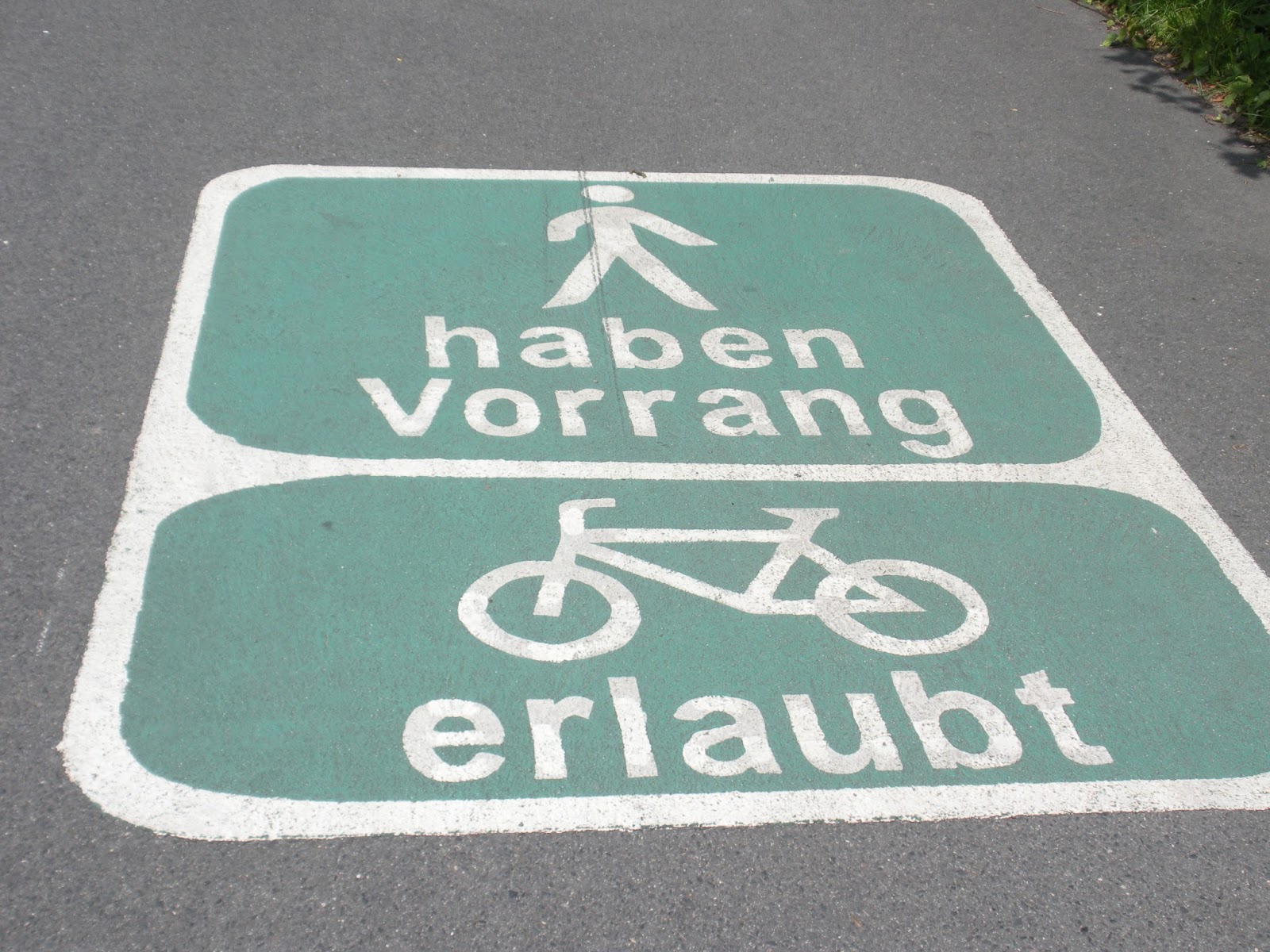
Pedestrians have the right-of-way, says the sign; bicycles are permitted.


Traffic sign on bike/ footpath.  June 2015, my photo.

**

Last time we made it (just) over the Brandenburg border, back into Berlin; so we are now, and will be for some time, in the Berlin district of Spandau. This is a tall thin district that takes up most of the western edge of Berlin, with the old city of Spandau--older than Berlin proper, and bigger than Berlin in early days-- approximately in the middle of the district. We haven't got as far as Spandau city yet; we're in the northernmost sub-district, Hakenfelde. Two-thirds of Hakenfelde is taken up by the Spandauer Forest, which is one of the biggest and most biodiverse stretches of woods in Berlin.

There are supposed to be 240 species of mushrooms in the forest here, for example. Do these Berlin-orange tree-fungi count as mushrooms, I wonder? (Orange is all over Berlin, it's the color of the city sanitation department. As the department is big on recycling and sustainability, its slogan, appearing on the orange garbage trucks, orange street-side bins, etc., is, "Only orange is so green.") 


Fungus on tree near Havel, June 2015, my photo.

Do other cities' garbage collection services have their own PR campaigns with slogans, I ask myself?? Did Chicago Streets and San have a slogan when we lived there? Nah, I think not. They certainly didn't paint little semi-clever remarks on the public trashcans. The one by our Bellevue S-Bahn stop was repainted at the beginning of the summer; it used to say something about dog droppings, but now it says Picobellevue. (This is a play on the German expression picobello, which means immaculately in order--or, to use another native German expression, tipptopp.)

Somewhere along here, in these open woods, I see a wild-strawberry patch--which would certainly be tipptopp at the right time of year. I investigate; but the fruit is only just setting, it's a long way from ripe.

Somewhere, also, I hear a cuckoo calling ...   Oh I went to the flowing spring where the water's so good, And I heard there the cuckoo as she called from the wood, says an Austrian folk-song. When my brother and I were children we used to sing it in the back seat of the car, out in the Colorado semi-desert where there were neither flowing springs nor cuckoos nor woods. 

**

Along with the three-thousand-plus acres of forest in Hakenfelde, there used to be a big coal-fired power plant and some heavy manufacturing. These were outliers of the big weapons-manufacturing cluster in Spandau city that supplied the German forces in the World Wars. (My brother and I used to play World War II on the living room floor on rainy days in the 1950s. He got to be the Americans and win; I had to be the Japanese and lose. Once when our forces were evenly matched for too long he raised the question of bringing in the Germans, but we were not sure which side they were supposed to be on.)

**

Spandau's history is military. Even a child would look at the location and say, "Hey, let's build a fort here!" Near where the Spree enters the Havel, a little northeast of Spandau city, there is a fortifiable piece of rock in the water, and it was fortified and defended for a thousand years or more, with varying degrees of success.  


Spandau Citadel. Photo, Dirk Reichel, Wiki Commons.

Spandau was all about the military. Berlin itself, before the late nineteenth century, was hardly more than a garrison town--a military post with a few civilian amenities clinging to it like fleas to a dog, and not always getting much more respect. 

It's easy to forget, or not to know, how intensely military central Europe was until quite recently: how dominant the noble-officer class was, how intensely its espoused values (authority, class, duty, hierarchy) permeated society. Vienna had more pretensions than Berlin as a civilized capital, but even Vienna still had more the flavor of an early-modern armed camp than any western European capital did. Military honor was the starch that stiffened social customs and gave them their local shape. 

I think the first piece of fiction that I ever read in German (with ill-educated astonishment) was Schnitzler's novella Leutnant Gustl, which appeared in Vienna in 1900. It drops you into a consciousness that would hardly have existed in England at the time, and is not possible to imagine in America. The young lieutenant in the story, in the crush around a concert-hall checkroom, allows himself to be jostled and then called "stupid boy" by the neighborhood baker. He should have drawn his saber to compel an apology (did English-speakers take their sabers to concerts in 1900? No), or he should have knocked the man down or ... But somehow in the confusion of the moment it doesn't happen, and he finds himself out on the street with the departing crowd. 

Because he has allowed himself to be publicly insulted by a man of lower standing, the lieutenant's duty under the code of honor is to kill himself. And he intends to do it the next morning, after a night of wandering through Vienna saying goodbye to the agreeable things of life. But on his way home in the morning to get his revolver to blow his brains out (apparently one does not take revolvers to concert-halls) he stops at his usual cafe, where the waiter tells him the neighborhood news: the baker died of a stroke during the night. So the baker can't tell the story about him, and no one else seems to have noticed the little incident, so ... No need for Lieutenant Gustl to shoot himself after all. (Gustl is a bit of a goof, and Schnitzler is not sparing with his ironies.)

But now the military is no longer here, either in Spandau or in the general social mores. It's as if there's a hole in history where the content has dropped away, like a frame with the (perhaps not very attractive) picture fallen out. 

The Spandau Citadel has become a venue for open-air concerts and other consumerist events. This summer the concert lineup runs from Limp Bizkit to Tom Jones (isn't he dead??) to Van Morrison. Later there will be a wedding-planning "Infoshow" here, where you can meet "all your partners for a successful celebration: wedding planners, caterers, limousines, pastry-chefs, suppliers of fireworks and wedding-doves [what?], jewelers, paper goods suppliers, speech-makers, stylists, photographers."  (Help, this sounds like too much. Archangel and I went to the Chicago City and County Building with a couple of friends and got married by a judge who gave us a nice speech about looking after each other, and then did some highly illegal electioneering--this was Chicago, after all. We had a champagne lunch at Marshall Field's afterward; we had kind of a good time. Could I think of the pigeons that lived at the Chicago Public Library as our wedding-doves? They were filthy beasts, but I suspect the ones at the dove-rental places aren't much better.)

Nothing against big celebrations, as long as people aren't putting them on only because they have to. (Poor Lieutenant Gustl thinks he has to kill himself; he's too much of an innocent goof to question it.)  Have to ...  "Nobody has to have to," says the classic German-enlightenment citation: Kein Mensch muss müssen. People should act based on their own sound reason and not on unexamined "have to"s. (Nice idea, limited realization.)

A scene from the play in which this line appears is represented in relief on the bridge over the river in our neighborhood. Do I know any American bridges with scenes from plays on them?  Nah, it's a different world.

**

I had thought the Spree (in outer reaches) was boaty and the Dahme was boatier; but the Havel is clearly boatiest. There are biggish boats in rows like cars in a parking ramp:


Boat tie-up on the Havel in Spandau. June 2015, my photo.

There are little boats nosed in among the water-lilies:


Along the Havel, Spandau, June 2015. My photo.

Spandau is changing in two directions these days. There are upscale folks moving in here, the people in the star-architect apartments right on the water, the people with the big boats. At the same time, scruffier parts of Spandau are filling up with people who have been pushed out of more central districts of Berlin by investors and developers who have to have higher returns on their property. As the socioeconomic indicators rise in Friedrichshain-Kreuzberg, they fall in Spandau.  

**

Of course the military wasn't everything in central Europe, even in the nineteenth century. There were un-military parallel universes, which were secondary to the military universe for a long time but not forever. Off the left, just here, the water widens out into the Tegeler See; on the other side is Schloss Tegel, where the Humboldt brothers in the nineteenth century were putting together important pieces of the modern sciences [see Tegeler Fließ 1 post, August 2014] and the modern research university. The sciences (in the German sense, not just natural sciences but all kinds of systematic knowledge) are one parallel universe. (Logic and evidence are different imperatives than authority and hierarchy.) 

Here on this side of the river is authority and hierarchy, however. This is Count Rochus zu Lynar, the Italian who was responsible for the state-of-the-art military engineering at the Spandau Citadel in the sixteenth century. 


Count zu Lynar, bust in Lübbenau.
Photo by Dr. Bernd Gross, Wiki Commons.

Lynar also built a palace for himself in central Spandau, which was later made into a prison. (Gone now, replaced by apartments.)  And how can you not smile, thinking of that fine man Carl Schurz, later an eminent US Republican Senator and Cabinet member, standing here in Spandau one cold night in 1850 trying to run a prison break? 

That was the other parallel universe, the much-repressed world of liberal politics in the illiberal Germany of roughly 1850-1950. One of the reasons that the US is much much more German than it was willing to admit after 1914, is the flood of Germans like Schurz who came as exiles or refugees or simply fed-up-with-its after the failure of the 1848 revolutions. (They had aimed to create constitutional monarchies on the British model, but the German monarchs weren't having it.)

One of the last outbursts of the 1848-1850 disturbances, after the failure of constitution-writing, was an attempt to set up a republic in southwestern Germany, in the Grand Duchy of Baden and the Palatinate. Carl Schurz, who had been studying history and philology at the University of Bonn, rather suddenly found himself as the amateur in charge of artillery for the revolutionary militia. Portions of the Grand Ducal army mutinied and joined the revolutionaries, but it didn't last past the fine days of early summer. Prussia, as guardian of order in the Germanic world, sent troops. The revolutionary and Grand Ducal amateurs were no match for the Prussians, who mopped them up in a month, trapping the last holdouts in the fortress at Rastatt. Schurz had been at Rastatt, but he and a friend slipped out of the fortress by way of a drain and made their way safe to Switzerland. 

They had left behind an older friend of Schurz's, a professor of art history and small-time poet named Gottfried Kinkel. (For the musically inclined: Robert Schumann provided a setting for one of Kinkel's poems.) Kinkel had more luck than many at Rastatt: he was not put in front of firing squad and did not die of typhus in the insalubrious conditions in which he and the other prisoners were held. But he was sentenced to life imprisonment, and after a few interim stops, he ended up in the prison in Spandau. 

Kinkel's wife (poet, composer, friend of the Mendelssohns, moderate live-wire in the intellectual world of 1830s Berlin before she went back to Bonn and married Kinkel) wrote to Schurz: Something has to be done, and done soon, before prison life destroys the last of his mental and physical strength. What is needed is a friend with courage, persistence, and skill. 

Schurz looks more or less like the man for the job: 


Carl Schurz as a young man.  From a book by C. Legler,
Leading Events of 
Wisconsin History.  Wiki Commons.

He made his way to Spandau with money and false papers, and organized some friends. Some of this (the money and probably some of the friends) had been set up by Frau Kinkel--but on the spot, how do you actually get your old professor out of jail? Schurz and the friends debate. Surprise the guards with a quick show of force by a handful of armed men, grab the professor and get out? No, too many soldiers within call; Spandau is crawling with soldiers. Smuggle a good file in to Kinkel and have him file through the bars of his cell window? No, says Schurz, Kinkel is too much of klutz, he can't do things like that. (Of course he does not say klutz; he says, in good German abstractions, the problem is Kinkel's Ungeübtheit in handlichen Verrichtungen.) Bribing a guard looked like the way to go, and after some false starts a bribable guard was found.

The bribee was supposed to steal the key to the cell and bring Kinkel out to the street door in the middle of the night. Schurz waited in the street, but it didn't happen. The keys weren't where the guard expected them to be, he couldn't find them, he couldn't do anything tonight, and all the difficult arrangements for getting out of Berlin and out of the country tonight would have to be canceled. (Persistence! as Frau Kinkel says.) 

The guard is willing to try again, but apparently he has got cold feet about bringing a prisoner right out the door: too conspicuous, too much chance of getting caught. But he's willing to let Kinkel down from a high window of the prison on a rope. Professor Klutz doesn't have to do much, just allow himself to be let down. And it works, albeit with much too much noise, as rope and professor knock out loose bricks and masonry on the ill-kept wall of Lynar's old palace. 

They make it safely away, in spite of all the noise--north to the Baltic and across the sea to Britain. Kinkel founds a German newspaper in London that flourishes, under other management, until 1914. Most of his time is spent creating the discipline of art history in Britain--the British haven't really been looking at it as a Wissenschaft yet. He lectures first at the South Kensington Museum (now the Victoria and Albert, now run by a German) and then at the University of London.

Schurz clears out to America ... What lives these people lead. He sells real estate in Wisconsin. He becomes an important figure in the Republican party. He makes campaign speeches in German for Abraham Lincoln, and Lincoln makes him the US ambassador to Spain. (Lincoln's Secretary of State is somewhat horrified--this man is a European revolutionary! What will the Spanish think?--but Lincoln doesn't back down.) In any case, the ambassadorship doesn't last long. When the Civil War starts, Schurz comes back to the US to fight for the North. He is a divisional commander at Chancellorsville, at Gettysburg, at Chattanooga. Industrially slaughterous battles of a kind that will come to Europe fifty years later. Europe, not having paid much attention to the American Civil War, has no idea what is coming. (Exception, for the musically inclined: listen to Vaughan Williams' settings of some of Walt Whitman's Civil War poems in Dona Nobis Pacem--most of this was written in the 1930s, but some just before World War I, and the music sounds as if it knows what is coming.) 

Later Schurz is a journalist, later he is a Senator from Missouri, later he is Secretary of the Interior. He takes steps to reduce corruption in the Bureau of Indian Affairs and get policy toward Native Americans out of the hands of the military, away from warfare as the primary policy instrument. 

Marion Countess Dönhoff [see previous post] tells a story about her father as a young man on an adventurous visit to America, riding through the Utah mountains with a small group including Schurz, to rescue captives and defuse tensions after an Indian raid on a white settlement. What conversations shall we imagine around the campfire, between the East Prussian nobleman, the anti-Prussian revolutionary, and--of all people--Walt Whitman, who had had a job for a few years at Indian Affairs and had been fired but was invited along anyway? 

**

Another of Schurz's activities as Interior Secretary was to try to convince the American population of the need for forest preservation. (You can take the German out of the forest, but you can't take the forest out of the German.) It was a little early for this to have much resonance in America, perhaps, but it was a nice try.


Along the Havel, June 2015.  My photo.

**

This is pleasant enough, along the river--the new residential building does not mostly hog the shore, and in places it even beflowers the public path handsomely:

Along the Havel, Spandau, June 2015. My photo.

But here I have got myself down into the Havelspitze, the peak or point of the Havel, which is a sort of peninsula extending south between the Havel on my left and a sizeable little bay on my right. It will be necessary to go back up the edge of the bay, around the top of it and down the other side; and this will land me up against a bridgeless side canal which will also have to be circumnavigated.  

Oh well, it's a nice day.

And voilà--it's not so far around the bay as I thought, because there's a new footbridge across a narrow place, a drawbridge, to let the sailboats through. (Chicago memories again: bridge after bridge opening along the Chicago River, like pairs of cockroach legs unfolding and waving in the air; and that queasy feeling when you were on foot in the middle of a (closed) bridge and saw a yacht coming--the bridge isn't going to open now, is it, before I get to the other side?)


Maselakebucht, footbridge. My photo, June 2015.

On the other side of the bay is a raggedy stretch of park. There are noble chestnut trees, and grazing geese (not as common here as in the US, not such a public plague):


Geese, Maselakepark, June 2015. My photo.

Where the foot-traffic has not been heavy, the paving stones of the path are rimmed with midsummer flowers :


Maselakepark, June 2015. My photo.

So, up the little canal we go on one side, down the canal on the other side, and back to the river, where the boats are starting to come out in the fine afternoon, full of the noisy and hilarious young. 


On the Havel, Spandau, June 2015. My photo.

On down the river for a bit, and then it's going to be time to pick up a bus and get home.  We're out of the woods, out of the new building projects, into a more urban world. Here is older housing, with tempting glimpses of inner courtyards from the street. 


On Parkstrasse, Spandau.  June 2015, my photo.

A different world, to pick up on another day. I go to the bus-stop street, which is a bit shabbier, and ... good lord, what IS that knock-you-flat-on-the-sidewalk perfume in the air? 

Oh, of course--it's summer. Linden-blossom overhead.

**

Kein Mensch muss müssen is from Act I of Lessing's Nathan der Weise.

The story about Kinkel's escape from Spandau prison is from Schurz's memoirs, as recounted in an article in Die Welt: http://www.welt.de/print-welt/article216019/Die-Flucht-aus-dem-Zuchthaus.html