The Britzer Verbindungskanal or Zweigkanal (connection or branch canal) is the branch off the Teltowkanal that connects directly to the Spree at the east end of Berlin. I have no very great hopes of it, because none of my three maps shows a path by the water for much of the way. To complicate things, the points at which they do show a path by the water are not the same from map to map.
But as it happens, all three maps turn out to be wrong, and it's a lovely walk.
**
Although the mouths of waterways are usually easier to find than their sources, the reverse should be true in this case, since the mouth of the branch canal is in a tangled mess of highway and harbor, but the source is at a clearly accessible spot on the Spree.
 |
| Junction, Britzer Verbindungskanal and Spree. February 2015. |
Here we're in Treptow, a little beyond the end of that pleasant wood with the dead amusement park in it, the Plänterwald [Spree 6 post, June 2014], and not far from the ferry that goes over this stretch of the Spree. Not that we could easily get to the wood or the ferry stop from here, however, because there is a fence with a locked gate along the Spree shore just west of the water-junction. Ah well, I wasn't going that way anyway.
The Spree runs northwest here, and I am going southwest along the canal. On my right hand is a park with a little hill in it, some thirty or forty feet high. (Artificial, obviously: hills are not natural to the banks of the Spree here.)
 |
| Toboggan run, Rodelberg, on Britzer Vebindungskanal. February 2015, my photo. |
It's a toboggan run, presumably with enough flat space at the bottom that your toboggan won't go flying out onto the river. (Which has been unfrozen all through this mild winter--no work for the city icebreakers this year. Just little skins and floats of ice sometimes in the morning after a sharp black night when the mufflers of cloud that keep in the warmth have lifted.)
This is an old hill, built in the 1920s and getting saggy and worn. The majority of the hills in Berlin are more recent: they're Trümmerberge, piles of World War II wreckage cleared out of the way and sodded over. (So it's 1946 or 47, you're hungry and cold, many of the people you used to know are dead; unimaginable crimes have been committed by your neighbors. The place you lived, the place you worked, the place you used to buy bread in the morning, are piles of rubble and ash. Under the piles are certainly unexploded bombs and perhaps undiscovered dead. What do you do with all this ruin? .... Well, the kids could use a sledding hill.)
**
There are good paths or sidewalks along the water until we hit the S-Bahn tracks. Then the canal goes under the tracks, but so far as I can tell, pedestrian access does not.
Okay, where is the nearest underpass that is usable by people without boats? Some way back, along Glanzstrasse. There are good apartment houses on Glanzstrassse, colors bright in the still-astonishing sun, in the bluebell-blue day.
 |
| On Glanzstrasse, February 2015. My photo. |
Someone has a Trabi parked in front of the building. A Trabant, the unmistakable East German auto. These rattling farting little vehicles have become collectors' items, nostalgia items: there are Trabi parades and Trabi tours. There are public discussions about the possible inappropriateness of nostalgia for the old East.
 |
| Trabant on Glanzstrasse. February 2015. My photo. |
Well, our parents only just escape being nostalgic for the Depression and World War II, which are not so attractive either. At least, most of the time they escape it; not always. It's a puzzle to me. My desire to be back in, say, the 1950s or 60s is near zero.
But people will think the world was right when they were young. I remember an old Berlin Conditormeister, a master pastry chef, whom I met in the late 1970s. He was born a little after the turn of the century and was nostalgic for the over-militarized Berlin of his childhood, when there was order. (Ordnung is a blessed word in German: in Haydn's great musical vision of the creation of the world, in the first aria in Die Schöpfung, the music lingers lovingly over the word: Chaos yields, says the libretto, and Ordnung, Ordnung grows up like green shoots in spring. Haydn's Ordnung is growth and life, not something mechanical or forced; but perhaps the pastry-chef's Ordnung was different.)
If you dropped a scrap of paper on the street in those days, said the pastry chef wistfully, there would be a soldier or a policeman there to make you pick it up. Nowadays there was no order. The present time, said the pastry chef, the present time is ... He was struggling to find words disdainful enough.
Finally he said, in a fury of disgust and frustration at his inability to express it, The present time is ... nothing special.
Die heutige Zeit ist nichts besonderes.
**
Here's the underpass, at the station. Because there is a station here, there must be a florist. (Otherwise, what would people do who are taking the S-Bahn to visit Aunt Hildegard? You can't arrive at someone's home without flowers.) Here's the florist; and there's another florist across the street, adding a little brightness to die heutige Zeit.
 |
| Primroses, Baumschulenstrasse. February 2015. My photo. |
It's primrose season at the florists'. Not primrose season in the woods yet, but soon. Here, where the sidewalk is narrow, the flowers are stacked on top of each other, shoulder-high. By the U-Bahn station in our neighborhood there is more room, and the flowers spread out for a couple of yards on the sidewalk, so that when I come and go to the grocery store or the post office or the dry cleaner, I am ankle-deep in a little sea of primroses and hyacinths.
**
But how do we get back to the water from here? Fare forth on good fortune, as the Grimm Brothers say. Try the first street going in the right direction. It turns out to be a good street, with pleasant architectural detail of diverse sorts:
 |
| Near Baumschulenweg S-Bahn, February 2015. My photo. |
Turn a corner, and the big apartment blocks seem very bright in the unfamiliar sunshine. (How things jump out at you in the light: how object-y they are, how solid in the bright day, after months of mist.)
 |
| On Kiefholzstrasse, February 2015. My photo. |
Oh dear, there's construction mess up ahead, making a busy street even harder to get across ... ah, but a temporary, portable Bettelampel has been put up here--literally, a begging stoplight, a light that turns red only when pedestrians push the button.
Ha. I love stopping cars.
And here we are back by the water. Here it is sheltered and mild, and the catkins have come out on the willows, tempting as kitten-fur to the touch:
 |
| Willow catkins along Britzer Verbindungskanal, February 2015. My photo. |
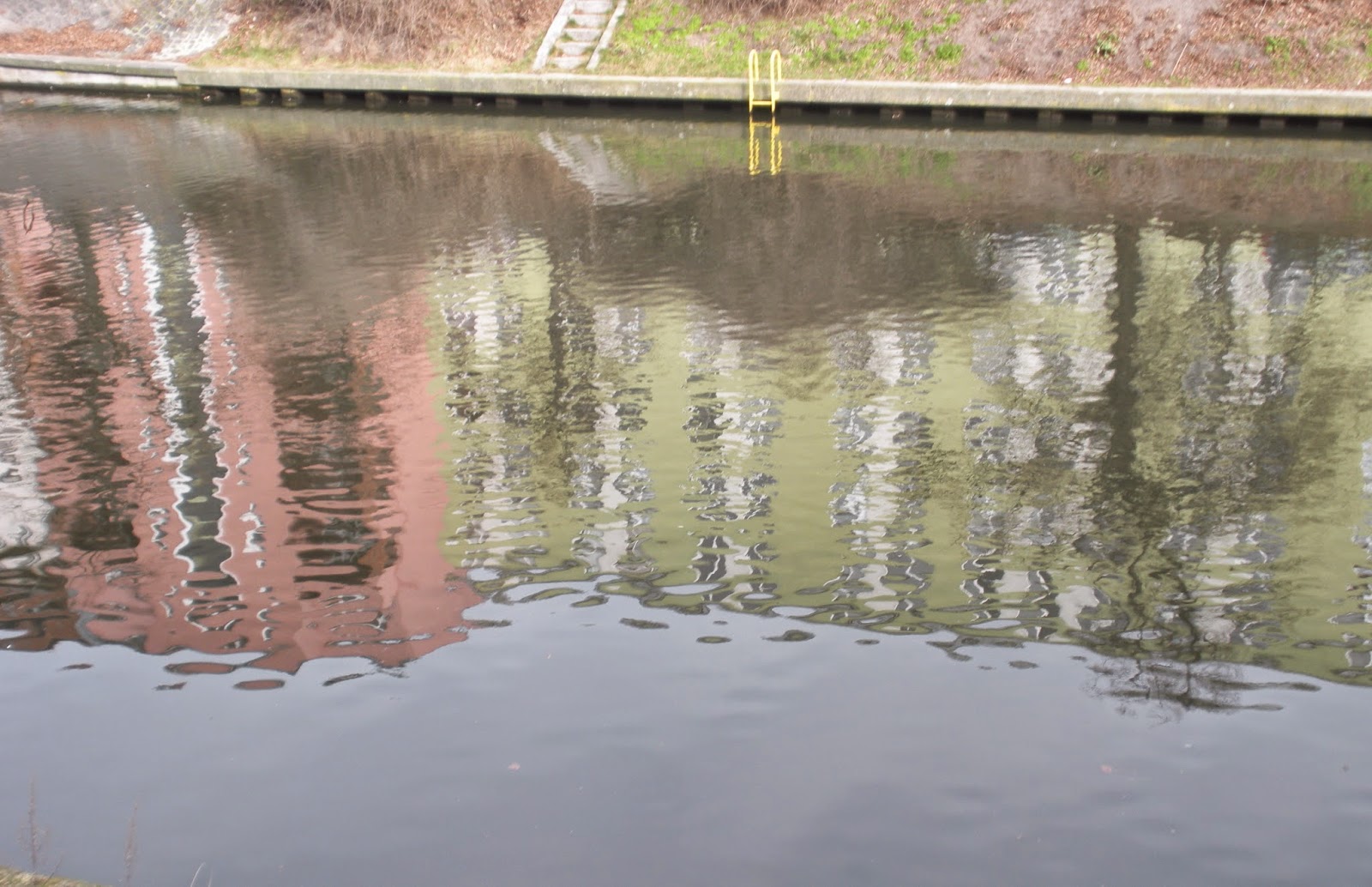
The water wobbles along, disturbing the willow reflections:
 |
| Britzer Verbindungskanal, February 2015. My photo. |
I go under the kindergarten-rainbow of the Südostallee bridge, a sun-yellow and cherry-red and sky-blue bridge. Based on the maps, I thought I would have to cross here, because I wouldn't be able to get farther on foot on this side of the water. But no, the little path goes on. How delightful and well-mannered of it. (In what other major capital does a fairly central part of the city look like this?)
 |
| Along Britzer Verbindungskanal, February 2015. My photo. |
I think we've used up our day's allowance of sunshine. It's clouding over, getting dim: the far side of the canal is misty, and the reeds on this side rattle in a light air that drags over you like silk dipped in ice water. Spring steps back a little, out of view.
 |
| Along Britzer Verbindungscanal, February 2015. My photo. |
The path gets smaller, between garden-walls and water, and I keep thinking it's about to dead-end at someone's private property, leaving me a long way to backtrack. But it keeps going. What fun it is to Indian along here, in this secretive little stretch of city, wondering what will come next ....
 |
| Along Britzer Verbindungskanal, February 2015. My photo. |
No locked fences, still; and here we are at a scruffy muddy bit of park. There is a sign along the water, warning of dredging work up ahead, so perhaps this is where we get turned back. But we'll see.
The word for dredging work is Nassbaggerarbeit, which a fine compound German word. A Bagger is an excavator or power shovel--or steam shovel, as we still said when I was small, though I don't think they were steam-powered any more then; a Nassbagger is therefore a Bagger for working where it is Nass, or wet.... This reminds me that the colloquial verb for hitting on someone, for over-aggressive flirtation, is anbaggern, to go at the person as if you were a steam shovel.
**
It is getting grayer and grayer. No sign of any Nassbagger, but here along the path is something that looks like staghorn sumac (Essigbaum, vinegar tree, in German), lifting its horns against the misty day.
 |
| Along Britzer Verbindungskanal, February 2015. My photo. |
And the path does go on, maps to the contrary. Roads go ever ever on, as Mr. Baggins said.
But here's an end at last, of a pretty decisive sort. The red fencing makes sure you don't go through the railings at the path-end by mistake if you're coming along at excessive drunken speed.
 |
| Chris-Gueffroy-Brücke, February 2015. My photo. |
Well, up we go on the little stair with the red railing; it looks as though the other side of the water has a footpath. And the view from the bridge solves a mystery of some weeks' standing: why does this end of Neukölln reek so of old coffee grounds [see Teltowkanal 5 and 6 posts]? This, presumably, is the answer:
 |
| Jacobs coffee-roasting plant on Britzer Verbindungskanal, February 2015. My photo. |
Jacobs has been owned by Kraft (which makes Maxwell House in the US) since the early 1990s, and I believe this is Kraft's biggest coffee-roasting operation in the world. No wonder the smell infests the whole neighborhood.
But let's see what is on the other side of the bridge ... A way forward? Yes indeed, this is the Mauerweg, the path that runs where the Berlin wall used to; the canal was the boundary here. The great thing about the Mauerweg is that although it is often lacking in charm as a place to walk, it is continuous, it will get you from point A to point B. So it will take us through the harbor-and-highway mess up ahead, which otherwise might be difficult to get through on foot.
 |
| Mauerweg at Chris-Gueffroy-Brücke, February 2015. My photo. |
I wonder mildly who Chris Gueffroy was, to get a street and a bridge named after him. A little farther along is a memorial column, which explains. He was the last person to be shot to death trying to escape East Berlin: a twenty-year old who, in February of 1989, believed the rumor that the guards along the Wall were not shooting people any more. Later the rumor was true.
**
It's rather pleasant along the path. Here are little birch groves and bramble thickets (blackberries in summer?), and artfully placed fallen logs to sit on and admire the passing water and passing bicyclists. Perhaps a place to come back to when the gray weather has gone and the green-and-blue weather has come.
Here we go under the (low, claustrophobia-inducing) highway bridge, which trembles under the truck traffic. Here is where the Britzer canal splits off from the Teltow canal.
 |
| Junction, Teltwokanal and Britzer Verbindungskanal, February 2015. My photo. |
There's no way across the water here to probable public transit, so we need to go south, along the opposite bank of the Teltow canal from where we were in the Teltowkanal 6 post. The highway is up above the path, on the left, and sometimes I can see the exit signs on it ... aha, there's a sign for the Späthstrasse exit, I know there's a bridge over the canal and a bus stop there. Here is a good ramp up from the path to the street level, and on the wall by the ramp is a version of the sinister-monkey graffito which I have seen in various other places around the neighborhood as well:
 |
| Ramp to Späthstrasse, February 2015. My photo. |
Well, goodbye monkey, goodbye Neukölln. Next time we need to start a new waterway.
By the time I get back to our neighborhood the sun is out again, the mists are gone, and someone's turned up the wattage on the sunshine spectacularly.